Garden Tools

Best Kids Gardening Tools of 2026

A kid who wants to help in the garden is a lovely thing — right up until the trowel bends in half on the first scoop of wet soil. Most children's sets are toys pretending to be tools: thin stamped metal, doll-sized handles, a blade that folds at the first real root. What you want is a scaled-down version of what you'd use yourself — short enough for a six-year-old to control, light enough to carry across the yard, and sturdy enough to survive a night left out in the rain.

Over four months this spring, my kids and a rotating cast of neighbor children put 14 sets through real planting, weeding, and mud, and the pattern showed up fast. Size is the thing parents underrate: a tool that's too long for a small arm gets used as a lever, and levers snap. Grips that fit a child's fist and metal that stayed straight after being shoved into clay mattered more than anything printed on the package. The ones that held up are below, along with a couple of budget sets that surprised us.

1

JustForKids 4-Piece Garden Tool Set

Top Pick
JustForKids 4-Piece Garden Tool Set

School-age digging

Our Score 9.6/10
Check Price

Worth Noting

  • Around 3 pounds, which is too much tool for a toddler
Set Weight
3 lb
Handle Length
Up to 27.5 inches
Tools Included
Rake, spade, hoe, leaf rake
Heads And Handles
Steel heads, wood handles
Read the full review

Twenty-seven and a half inches is what separates this set from nearly everything else we handled. That's long enough for a 5- or 6-year-old to stand up and rake or hoe with both hands, the way you do, instead of crouching over a trowel, and it's the reason this is the set we recommend first. All four pieces (rake, spade, hoe and leaf rake) carry steel heads on wood handles, and the binding where the head meets the handle is reinforced rather than simply pressed on, which is the joint that lets cheaper sets down after a month in the dirt.

Steel and wood also means weight: about 3 pounds for the set. On a school-age kid that reads as a proper tool, and the protective caps on the handle tops help when things get left lying point-up in the grass. On a 2- or 3-year-old the same heft is a liability, since a steel hoe head swinging at eye level is the thing you end up following around the yard. Stay with hand tools until they're big enough to control the swing.

You're buying four tools, not an outfit: no watering can, no gloves, no bag. We don't mind, because the build went into the heads and handles, and a plain steel rake stays useful long after a tote has gone moldy in the shed. One small annoyance worth passing on: the stained handles can leave color on damp hands for the first few outings. Give them a wipe before the first session and it stops.

Bottom line: For a kid of 5 or so who wants to actually work in the yard, this is the set we buy: steel heads, 27.5-inch handles, and a joint that holds.
2

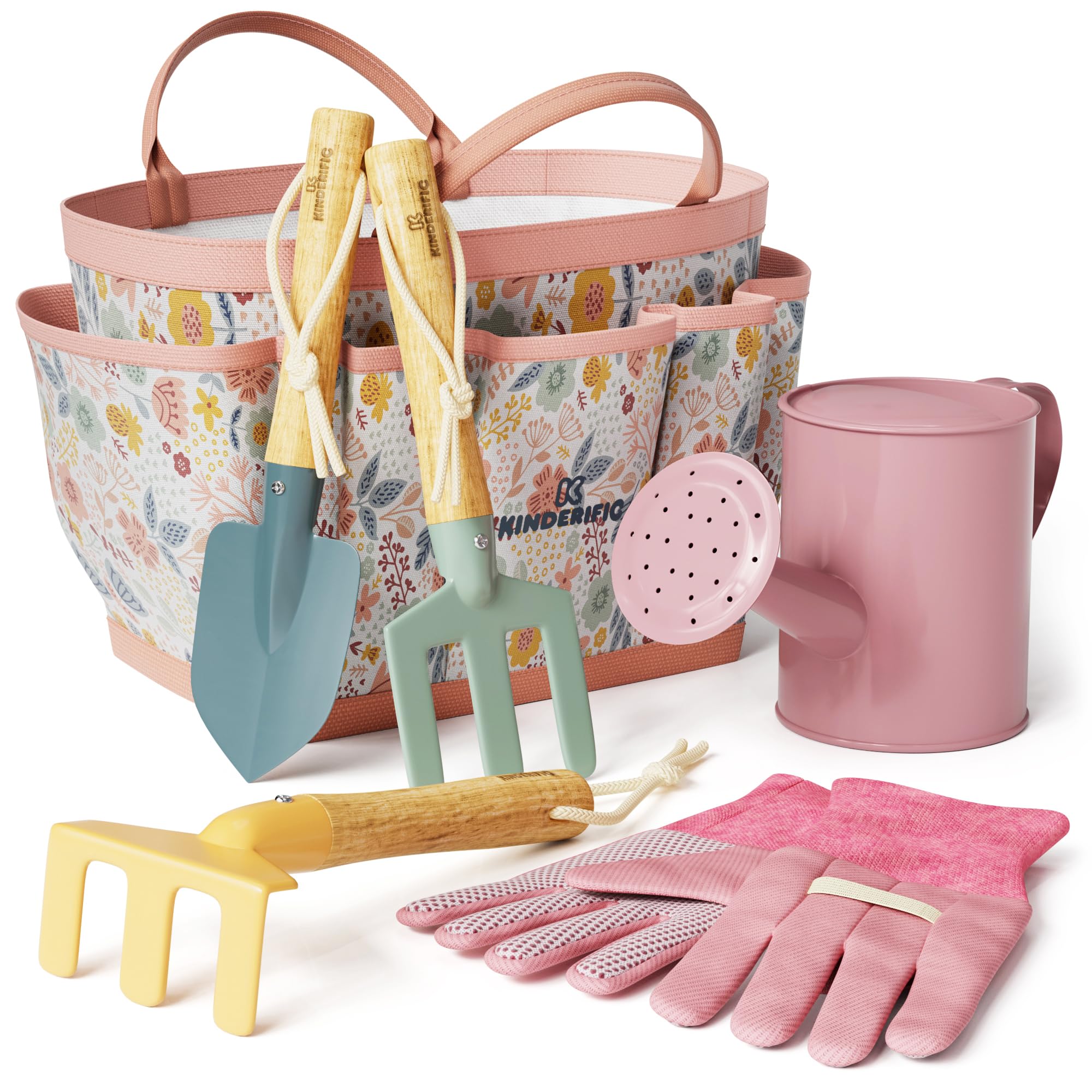
Kinderific Kids Gardening Set (6-Piece)

Kinderific Kids Gardening Set (6-Piece)

First-time toddlers

Our Score 9.6/10
Check Price

Worth Noting

  • Toddler-scale tools and a small can, so it runs out of road around age 5
Set Weight
1.4 lb
Watering Can
22 oz
Pieces Included
Tote, watering can, gloves, rake, shovel, fork
Recommended Age
2 to 8 years
Read the full review

A 22-ounce watering can is the piece that makes this set work for a 2-year-old. Watering is the one garden job a toddler can own from start to finish, fill and carry and tip and repeat, and a can they can lift when it's full keeps them busy while you actually plant. Around it you get a rake, shovel and fork with metal heads and wood handles, a pair of kid-sized gloves, and a stiff canvas tote to carry the lot.

Of the bag-based sets here, this is the one we hand to a 2- or 3-year-old. At 1.4 pounds the whole kit is light enough to drag from the porch to the bed and back, the tote stands open on the ground while they rummage in it, and nothing inside is precious enough that you'll mind it being left out in the drizzle. That last point matters more than it sounds: the set that gets used is the one nobody has to be careful with.

Where it gives ground to the Storybook kit further down is the extras, since there's no book, no plant stakes and fewer pieces in the bag. What it keeps is the build: wood handles and metal heads on all three tools, and a tote that holds its shape when it's set down in the mud.

Bottom line: For a first gardening set, this is the one we hand over: a can a toddler can carry full, three real tools, and a tote that survives the car.

3

Floraxa Kids Gardening Set with Metal Basket

Floraxa Kids Gardening Set with Metal Basket

Metal accessories

Our Score 9.6/10
Check Price

Worth Noting

  • Gloves are thin and run large
Tools
4 metal tools, wood handles
Basket
Metal
Watering Can
Metal
Pieces Included
8
Read the full review

The accessories are the argument. Most sets here pair a plastic watering can with a canvas bag, and those are the two pieces that crack, split or go moldy first, while this one includes a metal can and a metal basket. That alone puts it near the top of this group for anything that will live outdoors.

The tools are four metal-headed pieces on wood handles, sized for small hands with rounded grips. The basket is the sleeper: it gives a kid something to fill, which is a different afternoon from digging holes, and it's the piece that ends up full of rocks and leaves at the far end of the yard.

The gloves are the weak link, thin and cut large enough to slide off a toddler's hands, so plan on bare hands or a spare pair from your own shed. Beyond that the complaints are few, and the set only comes in pink, which narrows who it's for.

Bottom line: Worth it for the metal can and basket alone, and this is the set we point to when the tools will live outside.

4

G & F JustForKids Tool Set with Tote

G & F JustForKids Tool Set with Tote

Close-up weeding

Our Score 9.4/10
Check Price

Worth Noting

  • Hand tools only, with no long handles or watering can
Carry Bag
Canvas tote with pockets
Set Weight
12 oz
Tools Included
Hand rake, shovel, trowel
Heads And Handles
Metal heads, wood handles
Read the full review

The least expensive pick here is also the simplest: three tools, a canvas tote, and 12 ounces of metal and wood. A hand rake, a shovel and a trowel, all with metal heads on wood handles, plus a bag with real pockets that keeps the set together between sessions.

For close-up work, this is the set we like best. Small kids need short tools, since a 4-year-old digging beside you wants a trowel they can aim rather than a 27-inch hoe they have to wrestle, and these three cover weeding, scooping and turning over a pot's worth of soil. The heads are more substantial than the price suggests; the trowel has been borrowed for tight spots in the adult beds more than once.

The tote is the sleeper. It stands open on the ground, it has enough pockets that the tools don't end up in a heap, and it's roomy enough that it doesn't have to stay a kids-only bag, since a pair of snips and a ball of twine fit alongside the trowel without a fight.

Bottom line: This is the set we hand a 3- or 4-year-old who wants to dig beside us: three metal hand tools, a real tote, and nothing that breaks.

5

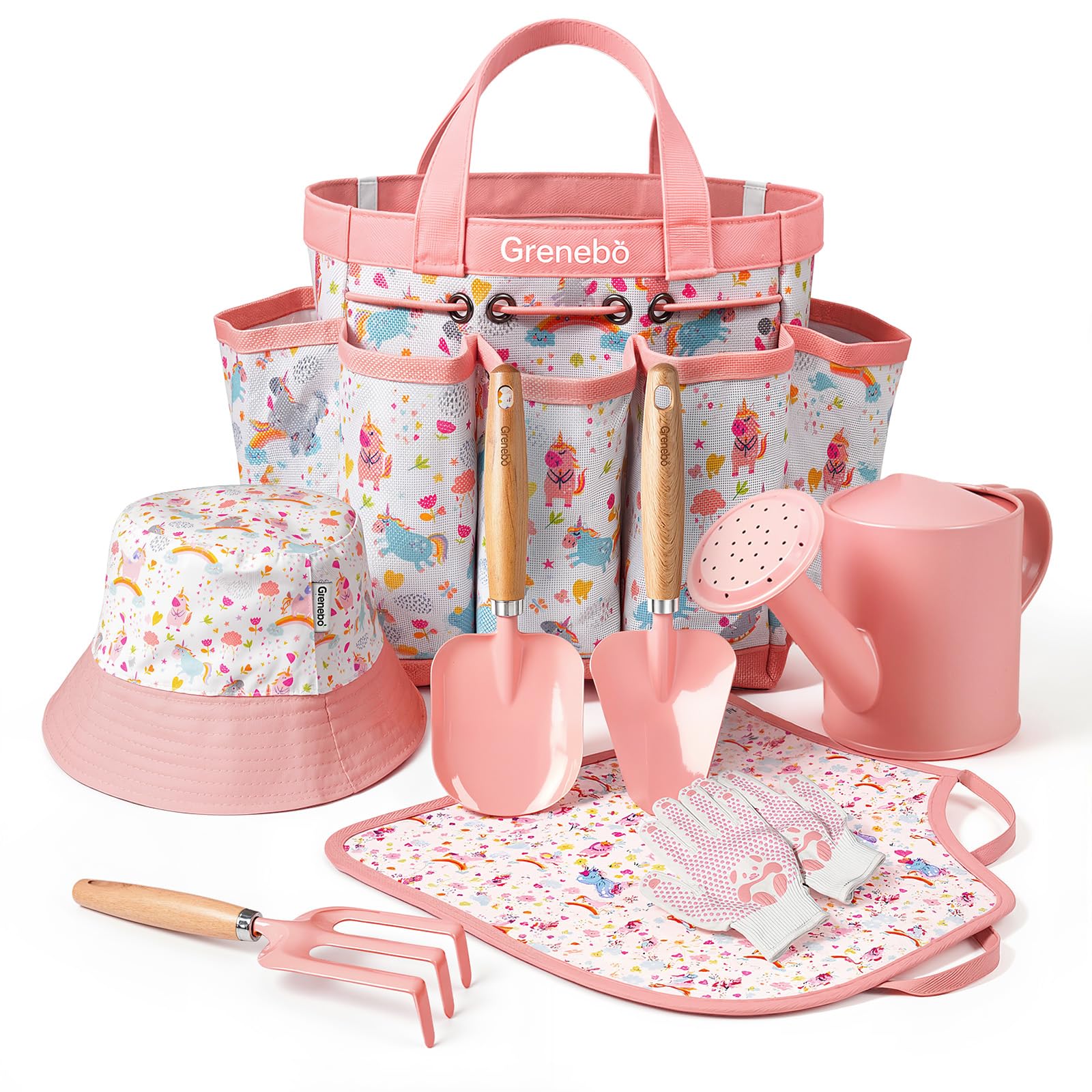
Grenebo Kids Gardening Set (8-Piece)

Grenebo Kids Gardening Set (8-Piece)

Dress-up gifts

Our Score 9.4/10
Check Price

Worth Noting

  • Apron and gloves run large on a 3-year-old
Material
Steel tools, wood handles
Also Included
Hat, apron, gloves, watering can, bag
Tools Included
Trowel, transplanter, cultivator
Recommended Age
3 to 8 years
Read the full review

The pink hat and matching apron are what a 4-year-old sees first, and that's worth more than a spec sheet admits: this is the set that gets worn, and a kid in an apron stays outside longer than a kid holding a trowel.

Under the outfit is real equipment. Trowel, transplanter and cultivator, all steel with wood handles and shaped like scaled-down versions of what's in your own shed, a narrow transplanter for setting out seedlings and a cultivator for breaking up crusted soil. There's a watering can, gloves and a tool bag to carry it all, and the can is sized so a preschooler can lift it when it's full.

The hat and apron are soft fabric with no chemical smell out of the bag, which we mention because the sewn accessories are where budget sets usually give themselves away.

Where it earns the gift tag is completeness: hat, apron, gloves, bag and four pieces of working equipment, all in one box, all in a matching pink that a certain kind of kid will be delighted by. Nothing here is a prop. The trowel will move soil, the can will water a pot, and the whole thing reads as a present rather than a starter pack.

Bottom line: This is the set we give as a present: hat, apron, gloves and three steel tools in one box, and the outfit is what gets a kid outside.

6

Storybook Kids Explorers Gardening Set

Storybook Kids Explorers Gardening Set

Learning to grow

Our Score 9.4/10
Check Price

Worth Noting

  • Tool heads can bend in hard, dry ground
  • Plastic handles, not wood
Extras
Guide book, plant stakes, tote, gloves
Handles
Plastic
Set Weight
1.2 lb
Pieces Included
11
Read the full review

Eleven pieces and a small guide book: this is the only set here built around teaching, and the book is the reason to look at it. It gives a kid something to read on a wet Saturday and turns a shovel into a conversation about how a seed actually starts.

The kit covers the practical side too, with metal-headed tools, plant stakes, gloves, a tote with deep pockets and a watering can shaped for a slow, controlled pour, which helps when the target is a seed tray rather than the patio. The stakes are the underrated piece, because a kid who labels their own row goes back to check on it.

The trade is at the digging end: these heads are thinner than the ones on the JustForKids set, and they can bend when a child leans on them in hard, dry ground. For a 4- to 6-year-old working soft soil and pots, that's a fair exchange for the book and the stakes. Push the same trowel into clay and you'll be straightening it.

Bottom line: The book is what sets this one apart, and it's why we keep it on the list for a 4- to 6-year-old who asks questions.

7

Qtioucp Kids Gardening Set with Wheelbarrow

Qtioucp Kids Gardening Set with Wheelbarrow

Hauling and dumping

Our Score 9.2/10
Check Price

Worth Noting

  • Plastic wheelbarrow tub scuffs where dirt is scraped
Item Weight
4.87 lb
Set Contents
Wheelbarrow, 7 tools, gloves, handbook, stickers
Recommended Age
3 to 8 years
Read the full review

A wheelbarrow changes what a kid does in a garden. Instead of digging a hole and wandering off, they fill, wheel and tip, which is a job with a beginning and an end, and that's the reason to pay for this set rather than a plainer one.

The rest of the kit supports it: 14 pieces altogether, with four long-handled tools, three hand tools, gloves, a garden handbook and five fruit-and-vegetable stickers. Heads are metal, handles are wood, and the long tools do the heavy work of raking leaves, breaking up clods and dragging spoil to the pile. The handbook is slim, but it gives a kid something to page through on a wet afternoon, and the stickers end up on the barrow, which is where they belong.

It's the priciest set in this group, and the barrow is smaller than the photos suggest: a few shovelfuls, not a load. We think that's the right call for a 3- or 4-year-old, because a barrow they can't push is one you end up pushing. A 7-year-old will treat it as a toy and go back to the shovel. What sells it in the end is the loop it creates, dig and load and tip and repeat, the only job in the yard a small kid can run end to end without you.

Bottom line: We buy this one for the hauling: a barrow a 3-year-old can push loaded, plus long-handled tools that do the real raking.

8

Egashow 6-Piece Metal Kids Tool Set

Egashow 6-Piece Metal Kids Tool Set

Sandbox play

Our Score 9.2/10
Check Price

Worth Noting

  • Too short to get leverage in real garden soil
Material
Iron heads, wood handles
Tool Length
8 inches
Tools Included
Cylinder, spoon, fork, rake, flat and pointed shovels
Recommended Age
3 years and up
Read the full review

Eight inches is the whole story. These are hand tools rather than garden tools, and knowing that up front is the difference between a great buy and a disappointment: they move sand, loose dirt and a sandbox with real authority, and they will not break new ground in a bed.

The six pieces are a cylinder scoop, a spoon, a fork, a rake and flat and pointed shovels, with iron heads on wood shafts. In a sandbox they're excellent. The metal is thick enough not to flex like the plastic toys they sit beside on the shelf, and the shapes are the ones kids actually reach for, the pointed shovel to dig, the flat one to scrape, the cylinder to make a tower.

Two things to expect. The shaft screws can work loose on a shovel, and a twist with a screwdriver fixes it in a minute. The painted heads also chip where they scrape concrete, which is cosmetic but inevitable if your kid digs along the patio edge.

As a garden set it stops at the dirt pile. There's no leverage in an 8-inch handle, and packed soil needs weight behind the blade that a 3-year-old doesn't have. As the cheapest way here to put a full set of metal tools into two kids' hands at once, though, it's hard to argue with.

Bottom line: If the digging happens in a sandbox or a dirt pile, this is the set we buy two of: real metal heads, six shapes, and one of the lowest prices here.

How We Tested the Best Kids Gardening Tools

We started with roughly 40 sets: the kid-sized lines from brands that already make adult garden tools, the toy-aisle versions, and the wooden-handled sets that turn up in every gift guide. We cut that list down by age range, whether the metal looked like stamped tin or actual steel, and whether the handles were shaped for a small hand or just painted a bright color. Fourteen sets made the cut, and they went home with four families whose kids range from three to nine.

Testing ran from March through June, which in practice meant a backyard raised bed, a community plot, and a patio potting bench. Kids planted peas and radishes, moved seedlings, dug for worms, weeded, and filled buckets while we followed along with a notebook. We watched where each child gripped — up at the handle or sliding down toward the blade — because a tool a kid can't hold properly is a tool that ends up bent. Every child also toted their own set from the shed to the bed and back, which is how we learned whose carry tote a four-year-old could actually manage alone.

For durability, we stabbed each trowel into a bucket of clay-heavy soil 20 times, then checked whether the blade had twisted on the ferrule or the handle had worked loose. We ran a thumb along every edge and handle seam looking for burrs or splinters, and left each set out overnight in the rain twice on purpose to see what rusted, swelled, or split. On value, we compared each set's cost against buying two or three decent single tools, since a set with a wobbling trowel isn't a bargain at any price. The sets that came through all of it are the ones below.

How to Choose

Match the handle to the child, not the box

Long-handled kids' tools run up to about 27.5 inches, which lands somewhere between waist and chest height on a 5- or 6-year-old. That length lets a child rake, hoe and break up soil with two hands and a straight back, and it is the single biggest reason a set gets used for more than one season. Hand tools run 8 to 12 inches and belong to close work: weeding, scooping, filling pots.

The mistake is buying the long set for a 3-year-old. Age ranges on the box are a rough guide at best; height and willingness to be corrected matter more. A tall 4-year-old can manage a long rake in open ground, while a small 6-year-old may still do better with hand tools in a raised bed.

Look at the joint, not the color

The part that fails on kids' garden tools is where the head meets the handle. A head pressed onto the shaft works loose after a few sessions, while a reinforced binding with a proper socket keeps going. Metal heads on wood handles are worth the step up from molded plastic, which flexes under load and tends to crack at the neck.

Real steel also means real edges and real weight. Give a 27-inch tool room to swing before you turn a child loose with it near a window box, and keep a close eye on under-5s, who tend to carry tools point-forward.

Tools or a kit?

A tools-only set ages well, because nothing in it can be outgrown except the tool itself. A kit with a tote, gloves, apron and watering can is what gets a reluctant kid outdoors, since the accessories are half of the fun. Decide which kid you have before you decide which box to buy.

The trap is accessory fit. Gloves, aprons and hats are routinely cut for the top of a set's age range, so on a 3-year-old they hang loose and slide off mid-dig. Buy with the older end in mind or expect to wait a season, and look closely at the sewn pieces, because a tote with real stitching outlasts a printed one.

What the can and the barrow actually hold

A 22-ounce watering can is a toddler's can: light enough to carry full, which means fewer spills and no handing it back and forth. The cost is refills, since watering a row of pots takes several trips. Bigger cans suit older children who can manage the weight when they are full.

Wheelbarrows are almost always smaller than the photos suggest. Judge one by whether a child can push and tip it loaded, not by how big it looks in the listing. A toddler-scale barrow holding a few shovelfuls gets used all afternoon; an oversized one becomes yours to push.

Frequently Asked Questions

Final Verdict

Weight and handle length, not piece count, decide whether a kids' gardening set gets used. For a school-age kid who wants to work beside you, the JustForKids four-piece is the set to buy: 27.5-inch handles that let them stand up and rake, steel heads, and a reinforced joint that survives real dirt.

If your gardener is 2 or 3, buy the Kinderific set instead, with a 22-ounce can they can carry full and three tools sized to a small fist, and keep the long handles until they have grown into them. The one thing worth paying up for either way is metal where it meets soil.