Tree & Forestry Care

8 Best Ripping Chain for Milling 2026: Get True Milling Performance

Which ripping chains actually cut along the grain without dulling fast? This guide helps farm and garden millers pick chains that match their saw's gauge, pitch, and drive links.

Every farm and garden miller knows the frustration of a new 'ripping' chain that goes dull after a few cuts. The reality is that many chains marketed for milling are simply standard cross-cut chains with a different tooth angle—they aren't designed to cut along the grain day after day.

The right ripping chain balances edge retention, cutter geometry, and fit. Semi-chisel chains handle dirty wood better but cut slower; full-chisel chains are faster in clean wood but require more frequent sharpening. Gauge and drive link count are non-negotiable—one wrong number and the chain won't tension properly.

Choosing a chain that matches your saw's bar, your typical wood type, and your tolerance for sharpening makes the difference between a productive day and a frustrating one.

1

KAKEI 36" 114DL Ripping

Top Pick
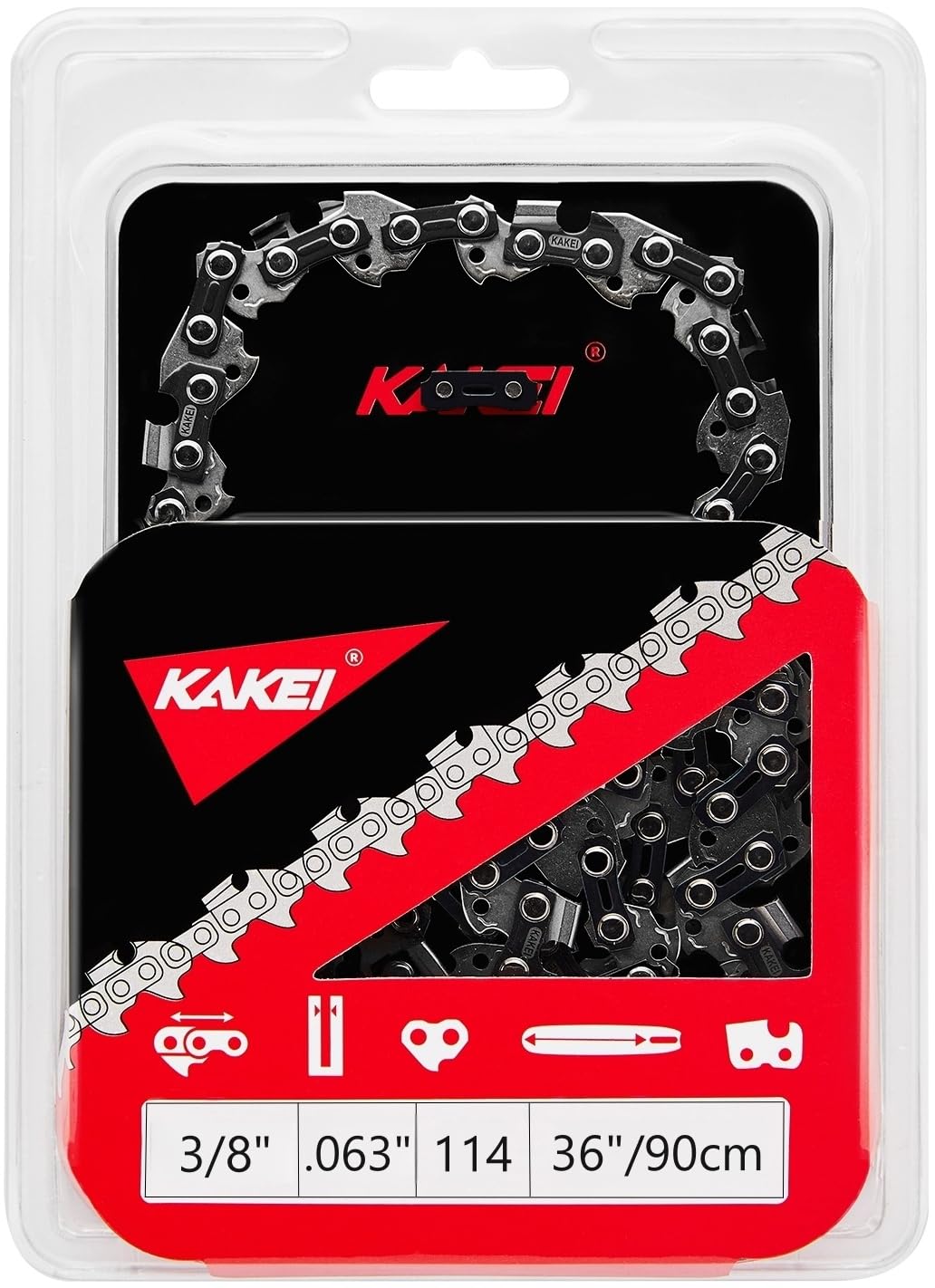
KAKEI 36" 114DL Ripping

36" bar saws

Our Score 9.2/10
Check Price

Worth Noting

  • On some bar/saw combinations, the chain may require minor tensioning or link removal
  • Occasional units may lose sharpness or chip when hitting embedded debris
  • Semi-chisel design cuts slower through clean softwood than full-chisel alternatives
Cutter Type
Semi-chisel
Gauge & Pitch
.063" / 3/8"
Drive Links & Bar
114DL / 36in
Read the full review

German steel alloy and chrome-plated cutters give this chain measurable longevity in heavy milling. Users report it holds its edge through days of cutting hardwood like oak and ash, while cutting aggressively enough that the phrase 'cuts like butter' appears regularly. The semi-chisel geometry trades a small amount of clean-wood speed for better tolerance of dirt and debris.

The .063 gauge and 114 drive links fit most large 36-inch bars, but anyone with a .050 gauge bar will need a different chain. In clean softwood, a full-chisel chain will cut faster — this chain is designed for millers who encounter dirty wood or want a single chain that works across varied conditions without requiring constant sharpening.

For millers considering premium options like Oregon, this chain delivers comparable milling performance at a lower per-unit cost. The value is especially clear when buying multiple chains for extended milling sessions. While occasional fit variations or dullness out of the box have been noted, the overwhelming feedback points to consistent performance that justifies the price difference.

Best suited for owners of 60cc+ saws running 36-inch bars who want a ripping chain that balances cost, edge retention, and cutting aggression. Not the right fit for anyone needing maximum speed in clean wood (look at full-chisel designs) or for saws with .050 gauge bars. The semi-chisel design is a deliberate tradeoff, not a flaw.

Confirm your bar’s gauge is .063 and drive link count matches 114 before ordering — some saws require minor adjustment for a perfect fit.

Bottom line: For millers running large saws who want a ripping chain that combines German steel durability with aggressive cutting at a cost-effective price, this is the most documented option on the market.

2

Oregon 72RD084G 84DL Ripping

Oregon 72RD084G 84DL Ripping

Dedicated mill use

Our Score 9.2/10
Check Price

Worth Noting

  • Some chains may arrive with a dull edge, requiring a touch-up before first use.
  • At its price point, value is subjective
Cutter Type
Full-chisel ripping
Gauge & Pitch
.050" / 3/8"
Drive Links & Bar
84DL / 24-28in
Read the full review

The Oregon 72RD084G is engineered specifically for milling with chain-type sawmills, integrating LubriLink and Vibe-Ban to minimize vibration and arm fatigue during long cuts. While the 72DL variant fits 20-inch bars, this 84-link version is meant for bars between 24 and 28 inches in dedicated mill setups. Users report clean, fast cuts on hardwoods like oak, with the full-chisel 10-degree grind delivering efficient rip-cutting along the grain.

This chain is for serious millers who prioritize consistent performance and reduced fatigue over cost. It is not recommended for hand-held use, so it belongs in stationary mill setups only. The price is premium, and some chains may arrive with a dull edge — a quick touch-up with a file before first use addresses that. For buyers who can tolerate that occasional step, the payoff is a smooth-running chain that stays sharp through long milling sessions.

If a chain arrives dull, a quick pass with a file restores its cutting edge before the first session.

Bottom line: If you run a chain-type sawmill and want a purpose-built, low-vibration chain that reduces operator fatigue during long hardwood cuts, the Oregon 72RD084G delivers — just be prepared for the occasional off-the-shelf dullness.

3

Archer .325 81DL Stihl Ripping

Archer .325 81DL Stihl Ripping

Stihl MS series

Our Score 9.0/10
Check Price

Worth Noting

  • Ripping performance out of the box is poor until manually sharpened.
  • Factory sharpness can be inconsistent; some chains arrive noticeably dull.
Cutter Type
Semi-chisel
Gauge & Pitch
.063" / .325"
Drive Links & Bar
81DL / 20in
Read the full review

This Archer chain slips onto Stihl MS261, MS271, and MS291 bars with .325 pitch without any modification — a cost-effective alternative to brand-name ripping chains for those saws.

The real value here is for owners who are comfortable with a file. Out of the box, the cutters can be dull enough that the chain struggles in wood. A quick touch-up with a round file changes that — once sharpened, it cuts cleanly along the grain, with several users describing it as 'like a hot knife through butter.'

This isn't a chain for someone who wants to open the box and start milling immediately. It's for the buyer who knows how to sharpen and is willing to spend ten minutes doing it before the first cut. The semi-chisel ripping geometry is appropriate for milling, but the factory edge needs attention.

Expect to re-sharpen the chain before it cuts well — a few minutes with a file transforms performance.

Bottom line: A budget-friendly option for Stihl owners with .325 bars, but factor in time for sharpening before first use.

4

8TEN 20" 2-Pack Ripping

8TEN 20" 2-Pack Ripping

Occasional millers

Our Score 9.0/10
Check Price

Worth Noting

  • Sharpness can vary between chains; some may require touch-up before first use.
  • Durability is inconsistent under heavier cuts
Cutter Type
Semi-chisel
Gauge & Pitch
.050" / 3/8"
Drive Links & Bar
72DL / 20in
Read the full review

The 8TEN 2-pack delivers good value for occasional millers who want a spare chain on hand without spending much. Ripping performance is decent for light work on softwoods or small projects. However, sharpness and durability can vary between units — some chains dull sooner than expected, and others may feel brittle. Limited user feedback and these inconsistencies keep it from competing with more established options. This set works best as a backup for short milling sessions, not for consistent daily use.

Bottom line: A practical spare set for occasional millers who accept possible sharpness and durability variance — not a primary chain for serious use.

5

8TEN 24" 84DL Ripping

8TEN 24" 84DL Ripping

24" bar saws

Our Score 8.8/10
Check Price

Worth Noting

  • Chain length can vary; count the drive links before ordering to ensure a proper fit.
  • Under heavy binding, the chain may lose teeth due to rivet quality variances.
Cutter Type
Full-chisel
Gauge & Pitch
.050" / 3/8"
Drive Links & Bar
84DL / 24in
Read the full review

The 8TEN 24-inch ripping chain cuts through hardwood like butter out of the box. This cutting speed typically comes from pricier chains, making it a cost-effective choice for moderate milling work.

This chain fits 24-inch bar saws like the Husqvarna 455 Rancher or Stihl MS 270, but it pays to verify the 84 drive link count before ordering, as fit can vary between saw models. Durability is adequate for occasional to medium-volume milling, though heavy commercial use may exceed its limits.

Buyers note the chain holds its edge through several hardwood cuts and sharpens easily with a file, reducing downtime. Its low unit cost means some users purchase multiple, finding it cheaper than professional sharpening.

Before ordering, count the drive links on your current chain to confirm compatibility.

Bottom line: For moderate-volume millers with a 24-inch bar saw, this chain delivers cutting performance far above its price point – just verify fit before purchase and avoid extreme binding conditions.

6

Oregon 72RD072G 72DL Ripping

Oregon 72RD072G 72DL Ripping

20" bar milling

Our Score 8.8/10
Check Price

Worth Noting

  • Some units arrive with a grind that requires manual sharpening before optimal cuts
  • For standard 20-inch bars, the chain runs long and needs a drive link removed for proper tension
Cutter Type
Full-chisel ripping
Gauge & Pitch
.050" / 3/8"
Drive Links & Bar
72DL / 20in
Read the full review

Oregon's 72RD072G ripping chain delivers clean, fast cuts through hardwood with noticeably less vibration than standard chains. The full-chisel 10° grind and LubriLink technology reduce friction during milling, making each pass smoother over long slabs. However, the 72-drive-link chain runs long for typical 20-inch bars, so removing one link is necessary to achieve proper tension.

This chain suits millers who already own Oregon equipment and are comfortable adjusting link count to dial in tension. It's less convenient for buyers expecting a drop-in fit on a 20-inch bar. The occasional need for manual sharpening out of the box is a minor inconvenience offset by the durability and precision of the cut.

If the chain is too long for your bar, remove one drive link and re-spin the rivet to maintain proper tension.

Bottom line: This Oregon chain cuts smoothly and reduces vibration, but the need to adjust link count makes it a better fit for millers comfortable with chain modification.

7

Archer 18" LP Ripping

Archer 18" LP Ripping

Small log ripping

Our Score 8.8/10
Check Price

Worth Noting

  • Semi-chisel design limits cutting speed in milling compared to full-chisel ripping chains.
  • Not a dedicated ripping chain
Cutter Type
Semi-chisel
Gauge & Pitch
.050" / 3/8"LP
Drive Links & Bar
62DL / 18in
Read the full review

On a 40cc saw, this chain handles occasional fence-post ripping without bogging down. The Japanese steel holds an edge decently for light use, and the low-profile design matches many homeowner-grade saws. However, the semi-chisel cutters are not optimized for milling — this is a standard cross-cut chain marketed as a ripping chain. In extended milling cuts, it wears quickly and cuts slower than dedicated ripping chains. Best reserved for small logs and fence posts, not for consistent milling or slab production.

Bottom line: This chain suits homeowners who need to rip a few fence posts or small logs with a low-power saw. For regular milling or demanding cuts, a dedicated ripping chain is a better investment.

8

Archer 20" 72DL Ripping

Archer 20" 72DL Ripping

Light duty milling

Our Score 8.6/10
Check Price

Worth Noting

  • In extended milling sessions, the chain can require frequent sharpening
  • Performance may not justify the price for those expecting a clear upgrade over OEM chains.
Cutter Type
Semi-chisel
Gauge & Pitch
.050" / 3/8"
Drive Links & Bar
72DL / 20in
Read the full review

The Archer 20-inch ripping chain provides acceptable performance on softwoods like cedar and oak for occasional milling. Sharpness and edge retention can vary between units – some chains arrive ready to cut, others require immediate sharpening. For users expecting a clear upgrade over standard OEM chains, the difference may be marginal. This chain fits light-duty jobs where consistent sharpening is part of the routine.

Bottom line: A reasonable pick for occasional ripping in softwoods if you are comfortable with regular sharpening.

How to Choose

Drive Link Count & Bar Length

The number of drive links determines how the chain fits on your bar. A 20-inch bar does not universally take 72 links; some saws use 70 or 74. Always count your existing chain's links or check your saw's manual before ordering.

A mismatch means the chain will be too loose or too tight, causing poor tension and premature wear.

Gauge & Pitch Compatibility

Gauge (the thickness of the drive link) must match your bar's groove. Common gauges are .050 and .063. Pitch (the distance between drive links, typically 3/8" or .325") must match the bar's sprocket. Mixing them causes chain slippage or damage.

Most farm saws use .050 gauge and 3/8" pitch, but larger bars often shift to .063 for strength. Verify both numbers on your bar's stamp before buying.

Cutter Grind: Ripping vs Cross-Cut

True ripping chains have a 10° filing angle, while standard cross-cut chains use 25-35°. The shallower angle cuts along the grain efficiently but dulls faster on contact with dirt. Full-chisel cutters (square corners) are faster in clean wood; semi-chisel (rounded corners) tolerate grit better.

For farm milling where logs often have embedded dirt or bark, semi-chisel extends life between sharpenings. If you mill only clean, debarked logs, full-chisel gives smoother, faster cuts.

Steel Quality & Heat Treatment

The steel alloy and hardening process determine how long the edge holds. Budget chains often use softer steel that dulls quickly, requiring frequent filing. Premium chains like those with German 68CrNiMo33 steel (found in KAKEI) resist wear significantly longer.

Chrome plating on cutters reduces friction and corrosion, but isn't common at budget price points. For occasional milling, standard steel is adequate; for regular use, investing in better steel reduces downtime.

Frequently Asked Questions