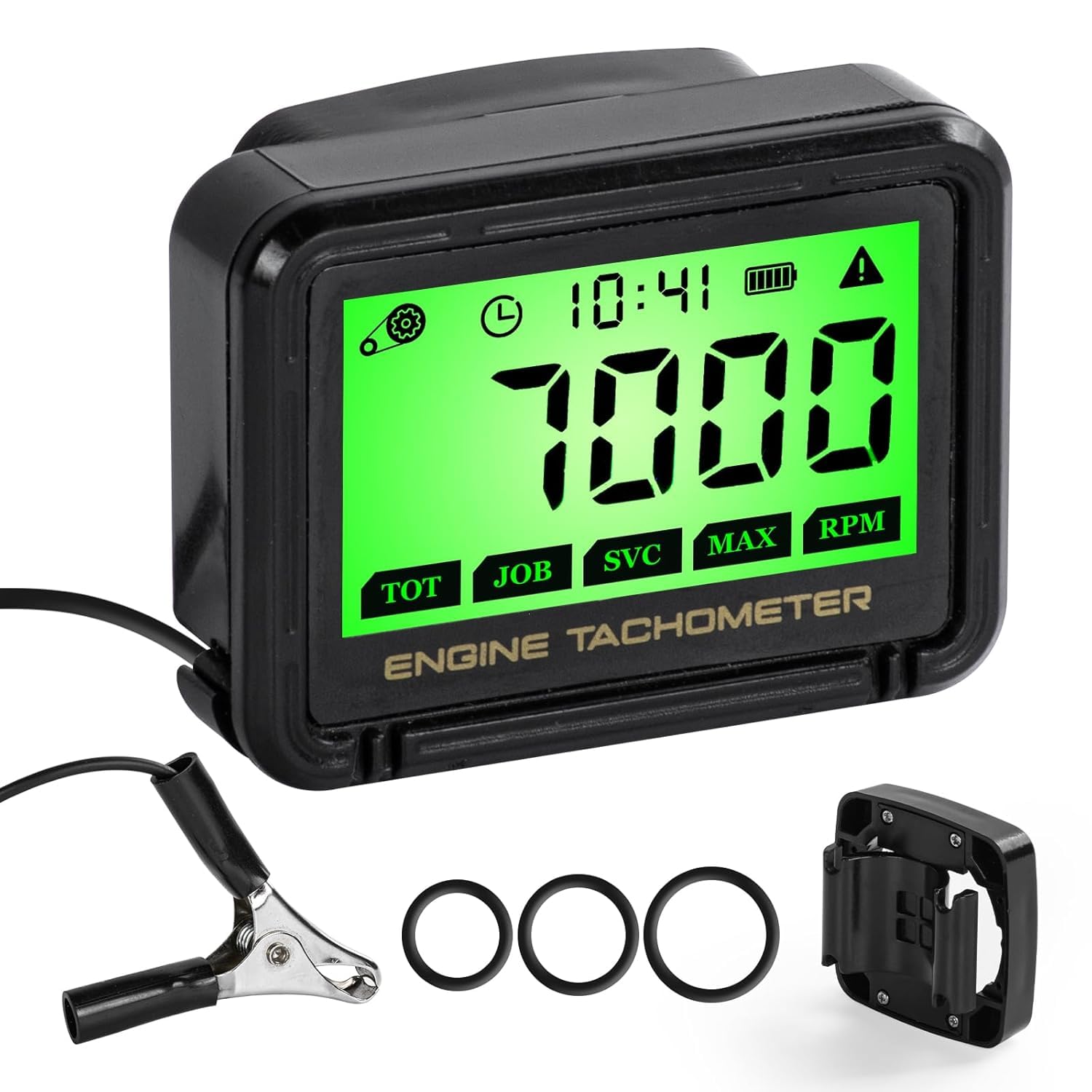
Outdoor Power Equipment

9 Best Small Engine Tachometer 2026: Replaceable Battery Picks for RPM

Which small engine tachometers give you accurate RPM readings and a replaceable battery so you don't have to replace the whole unit after a year.

If you have ever bought a cheap tachometer only to find the battery is sealed and the readings bounce around, you know the irritation. Many small engine owners treat these tools as disposable, replacing them every season. But a well-chosen tachometer should last years, not months.

The difference comes down to two features: a replaceable battery and a consistent inductive pickup. Sealed units often fail when the battery dies, while models with accessible batteries keep working. Our guide focuses on picking the right balance of accuracy, durability, and long-term value for lawn mowers, chainsaws, and generators.

Whether you need a permanent mount or a quick handheld check, the right tachometer saves time and fuel. No more guessing at idle speed or max RPM.

1

Hardline HR-8061-2

Top Pick
Hardline HR-8061-2

Long-term installations

Our Score 9.2/10
Check Price

Worth Noting

  • RPM readings can vary by ±20 RPM due to inductive nature
  • Limited to 1-2 cylinder engines only
  • Sealed battery lasts about 10 years then requires full unit replacement
Battery Type
Sealed lithium 10yr
RPM Accuracy
Waterproof Rating
IP68
Installation Method
Inductive wrap
Read the full review

Fully submersible up to IP68 standards and powered by a 10-year sealed lithium battery, the Hardline HR-8061-2 installs in seconds with a peel-and-stick mount and single inductive wrap – no wiring or ongoing battery swaps required.

This unit is built for owners of lawn mowers, generators, and outboard motors who want a set-and-forget tach/hour meter that withstands rain, pressure washing, and marine environments. The tradeoff is a non-replaceable battery – after roughly a decade, the entire unit must be replaced. It also only reads 1-2 cylinder engines, so skip it for larger multi-cylinder equipment.

The inductive pickup delivers consistent hour and RPM readings for maintenance and tuning, though some users note a slight ±20 RPM variation that doesn't affect practical adjustments. The sealed construction and adhesive mount hold up well in harsh conditions, confirmed by long-term use in outdoor and marine settings.

Bottom line: For anyone mounting a tach/hour meter on a mower, generator, or outboard that lives outdoors, the Hardline's waterproofing and dependable decade-long battery make it a smart choice despite the non-replaceable design.

2

Rotary 15344

Rotary 15344

Professional technicians

Our Score 9.2/10
Check Price

Worth Noting

  • Priced higher than many combo tach/hour meters that offer extra functionality.
  • Plastic casing can feel less robust than metal alternatives, especially in rough shop environments.
  • Non-replaceable soldered battery means the unit must be discarded when the battery eventually depletes.
Battery Type
Non-replaceable watch
RPM Accuracy
±10 RPM
Waterproof Rating
Installation Method
Inductive clip
Read the full review

Where budget induction tachs often waver at idle or high RPM, this handheld unit holds rock-steady readings across the 100-19,000 RPM range. The inductive pick-up clips onto the spark plug wire with no contact needed, and the large LCD updates every half second. Build quality feels solid and lightweight, with a simple two-button interface that gets straight to the measurement.

This tach is built for technicians who tune chainsaws, trimmers, and ATVs for a living and need repeatable results. The non-replaceable 3V watch battery is soldered in, so the unit becomes disposable once the battery dies — a tradeoff that matters less if you plan to use it for a few seasons and replace rather than repair. It also lacks an hour meter or maintenance reminder, so it is a dedicated tach only, not a multi-tool. DIY users on a tight budget will find better value in combo units that include those features.

To maximize battery life, disconnect the pick-up lead after each use to prevent idle drain.

Bottom line: If you need a dedicated, highly accurate handheld tach for professional small-engine work and can accept a disposable battery, the Rotary delivers precise readings where cheaper options fall short.

3

Briggs & Stratton 19200

Briggs & Stratton 19200

Battery-free tuning

Our Score 9.0/10
Check Price

Worth Noting

  • No hour meter or RPM logging
  • Requires practice to correctly read the vibrating reed; a digital display is more intuitive at first.
  • Cannot measure below 800 RPM, making it unusable for idle tuning on engines that idle lower.
Battery Type
None (mechanical)
RPM Accuracy
Waterproof Rating
Installation Method
Hold against engine
Read the full review

The Briggs & Stratton 19200 is a mechanical tachometer that requires no batteries at all. It uses a set of vibrating reeds that resonate with engine vibrations, giving a live RPM reading by simply holding the unit against the engine block. This design eliminates dead batteries, charging, or electronic failures — just pick it up and use it.

This tool suits owners of lawn mowers, generators, and small engines who want a maintenance-free instrument for occasional tuning. It works well on Briggs & Stratton engines and covers the typical operating range of 800 to 25,000 RPM. However, it cannot measure idle speeds below 800 RPM, so if you need to set idle on a small engine that runs below that threshold, you will need a digital tachometer. It also lacks any hour meter or data logging — it is a pure RPM indicator.

Using the reed tachometer takes a few tries to get comfortable. The vibrating reeds are read by identifying which one wiggles the most — a skill that becomes natural after a few uses but feels less immediate than a digital display. For traditionalists who appreciate a tool that works on physics rather than electronics, this is a satisfying and rugged choice.

Hold the tachometer against a flat metal surface near the flywheel — the reed that vibrates most is the RPM reading.

Bottom line: Best for owners who want a throw-it-in-the-toolbox tach that never needs batteries and are comfortable with analog readout.

4

HTPREC Clip Tach

HTPREC Clip Tach

DIY occasional tuning

Our Score 8.8/10
Check Price

Worth Noting

  • RPM readings can be erratic or incorrect on some units.
  • Manual is tiny and lacks clear mode guidance, making setup confusing.
Battery Type
Replaceable CR2450
RPM Accuracy
1%
Waterproof Rating
Installation Method
Clip-on induction
Read the full review

Works for basic carb adjustments on small engines thanks to its simple clip-on induction and replaceable battery. Accuracy can vary between units, and the sparse manual leaves mode selection up to guesswork. Battery access may also be tricky on some units, adding to the setup friction. While it costs similarly to the Gexmil, the combination of occasional erratic RPM readings and fiddly configuration makes this a backup option rather than a primary tool for regular use.

Bottom line: Best for occasional tuning of small engines when absolute precision isn't critical and you're willing to experiment with mode settings.

5

BIBARAJM Inductive Tach

BIBARAJM Inductive Tach

Ultra-budget disposable

Our Score 8.8/10
Check Price

Worth Noting

  • Battery compartment may be sealed, making replacement impossible without breaking the unit
  • RPM readings can be erratic or inaccurate on some engines
Battery Type
CR2450 (may be sealed)
RPM Accuracy
Waterproof Rating
Installation Method
Inductive clip
Read the full review

This budget-friendly tachometer works on most single-cylinder and small engines, offering a simple clip-on or inductive setup along with an hour meter and service reminder. However, the battery compartment can be sealed shut, making replacement impossible without damaging the unit, and RPM readings may be erratic on some setups. At this price, it is tempting, but spending a few dollars more on the Runleader RL-HM011F gets you a replaceable battery and more consistent accuracy — a better long-term bet.

Bottom line: Only consider this if the absolute lowest price is your priority and you can accept the possibility of a sealed battery and occasional accuracy issues.

6

HFWHOK Combo Tach

HFWHOK Combo Tach

DIY with alarms

Our Score 8.8/10
Check Price

Worth Noting

  • Setup instructions could be clearer for first-time users
Battery Type
Replaceable CR2450
RPM Accuracy
±10 RPM
Waterproof Rating
Installation Method
Inductive wrap
Read the full review

The HFWHOK Combo Tach offers a programmable RPM alarm and replaceable battery at a budget price, with auto-activation on engine start and simple mounting. However, limited long-term usage data means durability for frequent professional use is uncertain — it suits DIY enthusiasts who want the alarm feature without spending more.

Bottom line: Worth considering if you need a programmable RPM alarm and prefer a replaceable battery, but be aware of the limited track record for long-term reliability.

7

Runleader RL-HM011F

Runleader RL-HM011F

Homeowners tuning mowers

Our Score 8.6/10
Check Price

Worth Noting

  • Battery life can be shorter than expected, particularly with backlight always on.
  • Hour meter and clock may lose accuracy or fail to reset in some cases.
  • RPM accuracy can be inconsistent on certain engines, requiring trial with wire wrap placement.
Battery Type
Replaceable CR2450
RPM Accuracy
Waterproof Rating
IP65
Installation Method
Inductive wrap
Read the full review

The Runleader RL-HM011F combines an hour meter, tachometer, and service reminder in one compact unit that installs in minutes. Wrapping the pickup wire around the spark plug cable and mounting the display with the included bracket takes less time than reading the manual. The IP65 rating means it can handle rain and hose spray during routine deck washing, and the replaceable CR2450 battery avoids the disposal problem common with sealed units.

In actual use, the tachometer provides RPM readings that are close enough for carburetor tuning and idle adjustment on most lawn mowers, generators, and small engines. A small number of engines may require experimenting with the wire wrap orientation or insulation thickness to get a steady reading. Some units have shown the hour meter or clock drifting slightly over several months, and the battery can deplete faster if the display is left in continuous backlight mode. These quirks rarely interfere with routine maintenance tasks.

This unit fits the homeowner who tunes their own mower a few times a season, or the DIY mechanic working on a generator or pressure washer. The replaceable battery and maintenance reminder make it easy to track service intervals without swapping the whole device. It is not intended for professional mechanics who need ±10 RPM precision on every engine, nor for marine or rugged outdoor environments where a fully submersible design is necessary.

Wrapping the pickup wire firmly around the spark plug cable and trying a few wrap thicknesses can help stabilize RPM readings on picky engines.

Bottom line: For homeowners and DIYers who want a do-it-all hour meter and tachometer without spending extra, this Runleader is the practical choice.

8

Gexmil Handheld Tach

Gexmil Handheld Tach

Occasional RPM checks

Our Score 8.6/10
Check Price

Worth Noting

  • Instructions can be poorly translated and unclear, especially around firing pattern setup.
  • Build quality feels light and plastic, raising durability concerns for regular use.
  • RPM readings may be inconsistent, particularly at high revs above 8,000 RPM.
Battery Type
Built-in CR2450
RPM Accuracy
1%
Waterproof Rating
Installation Method
Handheld induction
Read the full review

The Gexmil Handheld Tach lets you check RPM without any wiring or installation — just hold the inductive pickup near the spark plug and get a reading. It covers a broad range of 2- and 4-stroke single-cylinder engines, making it a simple tool for occasional tuning sessions. The plastic housing and lightweight feel reflect the budget price, and readings can fluctuate or read incorrectly, especially at higher revs above 8,000 RPM.

This tach is suited for the budget-conscious user who needs a quick, ballpark RPM check during chainsaw or lawn mower maintenance. It's not built for frequent or professional use where consistent accuracy matters. For casual tuning where being close enough is acceptable, the Gexmil gets the job done with minimal hassle.

Hold the probe steady and let the engine warm up for best reading consistency.

Bottom line: For a quick and cheap check on a weekend chainsaw job, this tach works if you can tolerate some guesswork. If you need reliable numbers, look to a higher-priced option.

9

NInE-ROnG RL-HM032R

NInE-ROnG RL-HM032R

Wide firing patterns

Our Score 8.2/10
Check Price

Worth Noting

  • RPM readings may vary significantly from actual engine speed, particularly at higher rpm.
  • IP65 water resistance does not reliably protect against rain; moisture can enter the display area.
Battery Type
Replaceable CR2032
RPM Accuracy
Waterproof Rating
IP65
Installation Method
Inductive wrap
Read the full review

With 8 adjustable firing patterns covering up to 12-cylinder engines and a dual-color backlit display, this budget tachometer offers more flexibility than most competitors at a similar price point. However, the accuracy can vary by up to 500 RPM in some cases, and the IP65 seal does not consistently keep out moisture after rain exposure. Battery life is also short when the backlight is used frequently. These limitations make it a better fit for users who prioritize firing pattern options and are willing to accept potential inconsistencies in readings and weather protection.

Bottom line: For users who need support for a wide variety of engine firing patterns on a budget and are willing to accept occasional inaccuracies and limited weather resistance, this tachometer delivers the flexibility.

How to Choose

RPM Accuracy

Accuracy claims like ±10 RPM or 1% look good on paper, but real-world consistency depends on the pickup method and firing pattern setting. Handheld induction units are more prone to interference from nearby spark plugs, while clip-on or wrap-around sensors give steadier readings on single-cylinder engines.

For tuning carburetors, a variation of 50–100 RPM is acceptable for most small engines. Only professional mechanics need the extra precision of a ±10 RPM unit. If you are adjusting a lawnmower at idle, a budget tach that reads within 1% is sufficient.

Battery Type

Replaceable batteries are the single best predictor of a tachometer's lifespan. Sealed units with non-replaceable batteries die when the battery runs out, often within 1–2 years. A model with a standard coin cell like CR2450 lets you keep the tool working for a decade or more.

Some sealed units claim a 10-year battery life, but that only helps if the unit itself does not fail in other ways. If you plan to reuse the tachometer on multiple machines, choose one with a battery door.

Waterproof Rating

IP65 means splash-resistant from any direction, but it does not survive soaking or pressure washing. IP68 is fully submersible and is the only rating that can handle rain, hose-down, or marine use. Many budget units claim IP65 but have reports of moisture ingress behind the display.

For a tachometer mounted permanently on a lawnmower or generator, IP68 is worth the extra cost. For a handheld tool that stays in the toolbox, IP65 is adequate as long as you do not leave it in the rain.

Hour Meter and Reminder

An hour meter is essential for tracking maintenance intervals on engines without a built-in meter. Some tachometers also offer programmable service reminders that flash when the set hours are reached, which helps avoid forgetting oil changes.

If you only need RPM readings for tuning, skip the hour meter feature and save money. But for equipment like generators and lawn tractors, a combined unit eliminates the need for a separate hour meter.

Installation Method

Inductive tachometers use a wire wrapped around the spark plug cable to pick up electrical pulses. The number of wraps matters: 4–7 turns around the cable gives the best signal. Too few wraps cause erratic readings, too many can overload the sensor.

Handheld induction units are easier: just hold the sensor near the plug wire. But they require steady positioning and are less reliable at high RPM. Clip-on sensors offer a middle ground, with more stability than handheld and less fuss than wrapping.

Frequently Asked Questions