Garden Tools

Best Bonsai Tweezers of 2026

The first time I tried to pull a girdling root out of a root-bound juniper, I did it with my fingers and a pair of kitchen tongs, and I lost more fine roots than I care to admit. Bonsai tweezers exist for that exact gap: a long, narrow tip that reaches into a root ball, a wiring gap, or a clump of moss without crushing what's around it. What separates a pair that disappears into the work from one that fights you is how the points meet when they close, how the steel holds up after a hard squeeze, and whether the grip still feels right twenty minutes in. Get those right and repotting stops being a wrestling match.

I've kept trees on a bench out back for years, and this spring my team and I worked through 14 pairs over four months. One thing nobody tells a first-time buyer: overall length matters far less than tip alignment, and curved versus straight is really a question about which jobs you do. The picks below earned their spot by the potting bench — each one held up, felt right in the hand, and was worth the money.

1

LGEGE Long Handle Tweezers, 2-Piece

Top Pick
LGEGE Long Handle Tweezers, 2-Piece

Bonsai pot work

Our Score 9.4/10
Check Price

Worth Noting

  • Tips flex slightly under a hard pinch
Length
27 cm / 10.62 in straight; 26.5 cm / 10.43 in curved
Pieces
2, straight and curved
Tip Style
Grooved inner tips
Read the full review

Swap the curved LGEGE for the straight one and the reach barely changes: about 10.43 inches against 10.62. That's a tighter pairing than most two-piece sets manage, and it means the bent tip, the one that hooks around a trunk or slides under a surface root, isn't the short straw you save for easy jobs. Both tips carry grooves machined into the inside edge, so a leaf or a fine root sits in the channel instead of skating out the moment you ease your grip. With wet hands, that channel is the difference between lifting a seedling and chasing it across the bench.

We did most of our repotting with these, and the length is why. Ten and a half inches keeps your knuckles clear of the soil line and out of a cactus's reach while the tips do the small work: teasing apart a root ball, lifting a fallen leaf off the surface, pulling a weed that has rooted between two plants. The stainless is plain and uncoated, which we prefer. There's nothing to chip, and a rinse and a wipe leaves them ready for the next pot.

There's a boundary worth knowing. A 10.6-inch tweezer is longer than the classic bonsai pattern, and when you're wiring a thin branch on a small tree your fingertips sit noticeably further from the work than they do on a six-inch tool. For detail at that scale we reach for the Alfaly set instead; for everything else, this is the pair we keep picking up.

Bottom line: This is the pair we tell most people to buy: two tips that reach the same depth handle repotting, weeding, and leaf work without a second trip to the shelf.
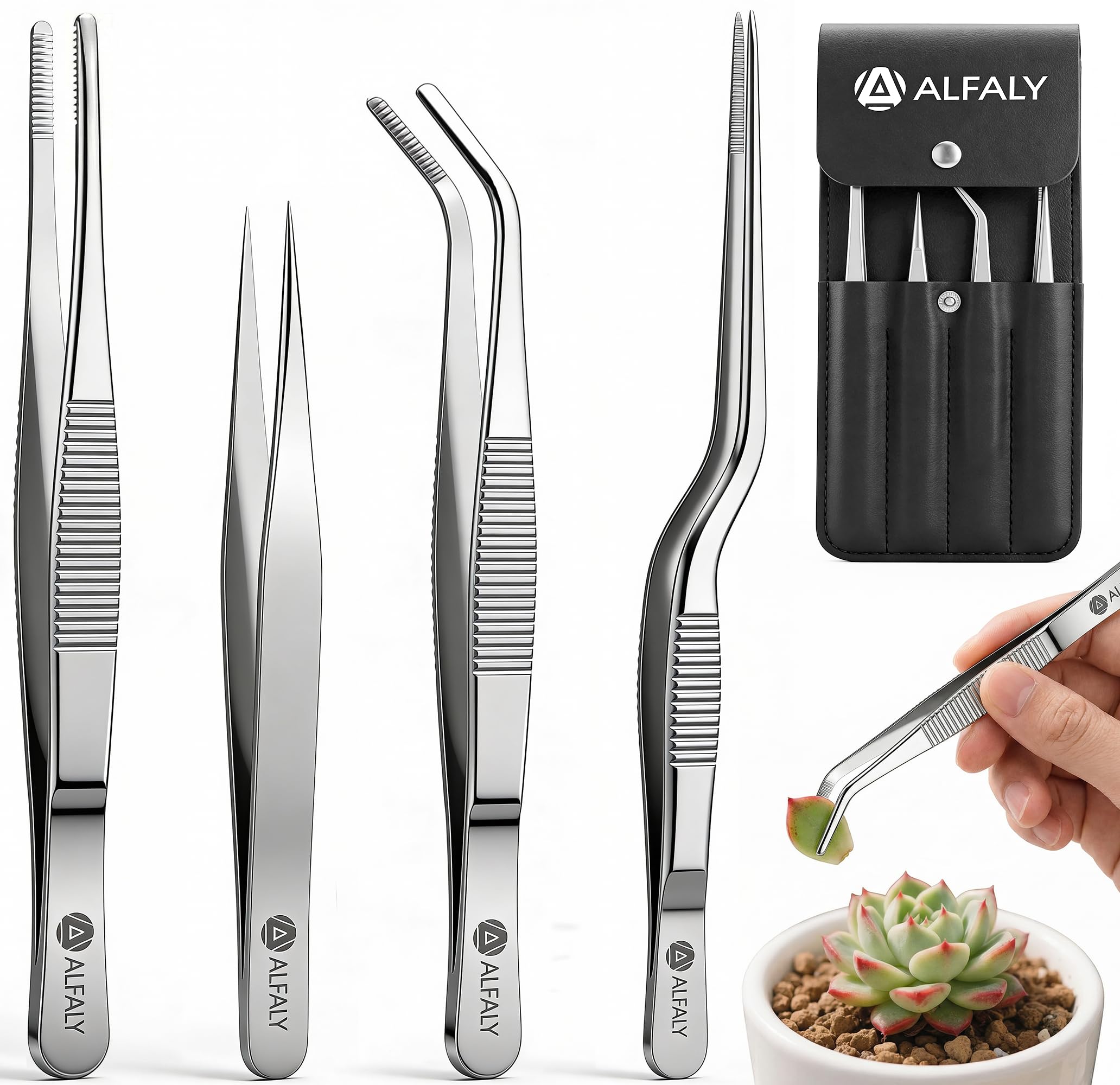
2

Alfaly Garden Tweezers Set, 4-Piece

Alfaly Garden Tweezers Set, 4-Piece

Seedlings and succulents

Our Score 9.4/10
Check Price

Worth Noting

  • 6.3 inches can't reach into a deep pot
Length
6.3 in
Pieces
4
Includes
Storage bag
Material
Stainless steel
Read the full review

Four tweezers in one pack usually means four ways of doing the same thing. Here it doesn't: the Alfaly set is four short tools with fine tips, and the length is what makes them a different animal from the 10- and 12-inch pairs on this list. At 6.3 inches your fingertips sit close to the tips, so you can feel how much pressure is going through them, and that closeness is what we like about them. Separating seedlings, lifting a single dried leaf off a succulent, nudging a seed into place: this is the scale they're built for.

The tips are the finest of the four picks here, and short arms mean you can open them a fraction of an inch and still control it. We used them most over a tray of seedlings and across the surface of a shallow succulent pot, where a longer tool would have had us working blind over the rim. The storage bag is a small thing that turns out not to be: four loose tweezers in a shed drawer have a way of becoming three by spring.

Buy them as the detail tool rather than the only tool. Six inches doesn't reach the bottom of a deep pot, and it won't get past a cactus to the soil behind it; that's a job for the LGEGE or the HSTECH. As the pair that lives in an apron pocket for the fiddly five minutes at the end of a repot, though, it's the one we reach for first.

Bottom line: If your work happens at close range, on seedlings, small succulents, one leaf at a time, we think this four-piece set is the most precise here.

3

HSTECH 12-Inch Tweezers, 2-Piece

HSTECH 12-Inch Tweezers, 2-Piece

Deep, spiny jobs

Our Score 9.2/10
Check Price

Worth Noting

  • Serrated tips are coarse for fine wiring
Length
11.8 in
Pieces
2, straight and curved
Material
Stainless steel
Tip Style
Serrated tips
Read the full review

Set the HSTECH pair next to our top pick and the difference is an inch and a half of steel: 11.8 inches overall against 10.6. That extra reach is the whole argument for them. A deep planter, the back corner of a terrarium, the gap between two cacti you don't want to lean over: these get your hand there and back without a glove.

In a bonsai pot we treat them as the heavy-hand option, and that's a compliment rather than a demotion. The serrated tips bite, which is exactly what you want for dragging a weed out of a root mass or lifting a fallen leaf off a spiky rosette, and the ridged handles kept their grip when our hands were muddy. What we paid close attention to was the spring at the pivot, since long arms are where a cheap pair shows itself, and this one closes cleanly along the tip without crossing. You also get a curved forceps in the pack, and it hooks around a pot rim without your hand following it in.

Where they fall out of favour is a small pot. Twelve inches of tweezer over a shallow bonsai container is more tool than the job needs, and you feel the extra length every time you try to place something a quarter inch to the left. Buy them for the deep, awkward, spiny work and keep a shorter pair on the bench.

Bottom line: We keep this pair for the deep, spiny, wet jobs, where the extra reach and the biting tips do what a shorter tool can't.

4

KMHIGH Gardening Tweezers Set, 3-Piece

KMHIGH Gardening Tweezers Set, 3-Piece

Grip-heavy garden tasks

Our Score 9.2/10
Check Price

Worth Noting

  • Toothed tips are coarse for delicate wiring
Pieces
3
Lengths
6.15 in, 6.3 in, 6.5 in
Tip Style
Toothed inner tips
Read the full review

The three forceps in the KMHIGH set run from 6.15 to 6.5 inches, a third of an inch between the longest and the shortest. That's not a graduated set whatever the listing implies; the real difference between them is shape, with a straight design and an elbow design in the pack, so what you're buying is angle variety rather than a run of sizes.

What sets them apart is inside the tips: a row of teeth that closes on a stem and holds it. That's the reason to pick these over a smooth-tipped pair when your work is grip-heavy, whether you're dragging a weed out of a crack, holding a cutting steady while you tie it on, or lifting a wet leaf that a smooth tip slides straight off. The elbow version gets you around a rim or behind a trunk without rolling your wrist, and the whole set is light enough to work through a full repotting session without cramping.

What they lack is length. At six-ish inches they sit in the same class as the Alfaly set, which means small pots, seed trays, and surface work rather than the bottom of a deep container or the far side of a cactus bed. Three tools at a budget price makes them an easy second set to keep in the shed, and having both shapes on hand means there's usually one that fits whatever angle you're stuck at.

Bottom line: We reach for these when the job is grip-heavy rather than delicate: three shapes, toothed tips, and a budget price that makes them an easy second set.

How We Tested Bonsai Tweezers at the Potting Bench

We started with a list of about 40 pairs sold for bonsai work and fine horticulture — long stainless tweezers, short curved ones, coated tips, spring-loaded models — and narrowed it to 14 based on tip shape, joint construction, and what buyers reported about how the points lined up straight out of the package.

Testing ran through a full spring repotting season and into summer, four months total, at a bench in a backyard and at a kitchen table when the weather turned. We used each pair for root work on junipers and maples, for threading wire on a black pine, for lifting single strands of moss and picking scale off leaves, and for clearing grit out of drainage holes.

Grip got its own attention: we used pairs with wet hands after watering, with dry hands, and with nitrile gloves on, noting whether the tool rotated, slid, or forced a death grip. For sturdiness we squeezed hard on a block of hardwood, flexed the tips against the bench edge, and dropped each pair from bench height onto concrete to see whether the points still met flush afterward. We ran a fingertip along every joint looking for burrs and checked the pivot for wobble. Convenience came down to weight and whether a pair slipped into an apron pocket and came back out without snagging. And we worked the least expensive pairs alongside the most expensive to see whether the extra money bought anything you could actually feel.

How to Choose

Tips first, length second

Tip design decides what a tweezer is actually good for, and it's the specification listings bury under the length. Smooth or grooved tips close on a leaf and hold it in a channel; serrated and toothed tips bite into stems and debris. We reach for the smooth style for anything that stays on the tree, whether that's a bud, a new shoot, or a root you're guiding into a pot.

Keep the biting pair for pulling weeds, clearing surface debris, and dragging a fallen leaf off a cactus. If you're buying one pair, buy the smooth one. It handles the delicate work and most of the rough work too, which a serrated tip can't say in reverse.

Match the length to the pot you actually own

Length is leverage and distance at once. A six-inch tool puts your fingertips close to the work, so you feel the pressure and can adjust by a fraction; a 10- to 12-inch pair keeps your hand clear of soil, spines, and the far side of a deep container.

The trap is assuming longer means more precise. Every extra inch amplifies a small wobble at your wrist, and over a five-inch bonsai pot a 12-inch tweezer feels like chopsticks. Bench trees in shallow pots want something around eight to ten inches; deep planters, cactus beds, and terrarium corners want 11 or 12.

Straight, curved, or a set

A curved tip hooks around a trunk, a rim, or a branch and works at an angle your wrist can't reach. A straight tip is what you wire with, lift with, and use for anything directly below your hand.

Most good sets now pair them: the LGEGE and HSTECH two-packs each give you one of each, and the Alfaly four-piece covers both shapes across its set. The second tool adds very little to what you spend on the first, and the curved one isn't a gimmick. It's what saves you from tilting an entire pot to get at the back of it.

Check the spring before you trust the tip

Tweezers are only as good as the alignment of their two arms. Close the tips and hold them up to the light: the last few millimeters should meet with no gap and no crossing. A pair that flexes under a hard squeeze will eventually stay bent, and once the tips stop meeting flush they stop holding anything.

That's also why we don't pry with them, dig with them, or use them to lever a root ball apart. The tips lose that fight. It's an inexpensive tool; treat it like a precision one and it keeps its spring for seasons.

Frequently Asked Questions

Final Verdict

The LGEGE pair is what we recommend to most people, because two tips that reach the same depth cover repotting, weeding, and leaf work without a second purchase.

If your plants live in small pots or you spend your time on seedlings, the Alfaly set's fine 6.3-inch tips give you control the long tools can't. For deep, spiny, awkward corners, take the extra reach of the HSTECH pair.