Soil & Fertilizer

5 Best Fertilizer Spikes of 2026: Spikes That Fit Your Plants Without Crumbling

Struggling with fertilizer spikes that crumble or don't match your plants' needs? This guide helps garden and farm owners pick the right NPK spike for indoor, outdoor, trees, or blooms.

Fertilizer spikes promise the ultimate convenience: just push in and walk away. But anyone who's hammered a spike into hard soil only to watch it crumble knows the reality isn't that simple. Broken spikes, uneven release, and the wrong NPK can leave plants hungry.

The solution isn't avoiding spikes altogether — it's choosing the right one for the specific job. Indoor plants need a different formula than outdoor trees, and organic options often come with an odor trade-off. This guide cuts through those trade-offs to help you match the spike's NPK, durability, and coverage to your specific plants, so you get the convenience without the frustration.

From houseplants to citrus trees to maples, the best spike is the one that actually works for your garden mix.

1

Old Farmer's Almanac 6 Ct

Top Pick
Old Farmer's Almanac 6 Ct

Natural tree care

Our Score 9.2/10
Check Price

Worth Noting

  • Only six spikes per package limits use to small landscapes
  • Spikes may crack when driven into dry or compacted soil
NPK
13-3-3
Count
6 spikes
Target
Trees, evergreens, shrubs
Read the full review

The Old Farmer's Almanac tree spike uses natural ingredients and holds together better when driven into soil than the leading competitor. This 13-3-3 formula is designed to revive struggling trees and shrubs without synthetic chemicals. The included money-back guarantee reduces the risk of trying it.

This six-count pack suits small yards with a handful of trees or shrubs. For larger landscapes, the limited spike count becomes a constraint. While most spikes install smoothly, occasional cracking during insertion has been noted — a manageable tradeoff for the natural composition.

If your soil is hard, pre-wetting the insertion point can reduce the chance of the spike cracking.

Bottom line: Ideal for organic gardeners with a small yard who want a natural option with a performance guarantee.

2

Jobe's All Purpose 50 Ct

Jobe's All Purpose 50 Ct

Mixed gardens

Our Score 9.0/10
Check Price

Worth Noting

NPK
4-4-4
Count
50 spikes
Target
All purpose (vegetables, flowers, shrubs, trees)
Read the full review

The balanced 4-4-4 NPK formulation feeds a wide range of plants without the need for multiple products. It is OMRI-listed organic, so it fits into any organic garden routine, and application is simple: push a spike into the soil – no mixing, no odor, no mess. Plants show visible improvement within a couple of weeks.

This spike suits gardeners who want one product for everything from tomatoes to roses to houseplants. It is especially forgiving for beginners because the slow release reduces the chance of over-fertilizing. However, the spikes can splinter if handled roughly or pushed into very dry soil, and mold may form in pots that stay soggy – careful handling and moderate watering keep these issues at bay.

Bottom line: Buy if you want a single organic spike for most garden and house plants, and you are comfortable handling them carefully to avoid splintering.

3

Miracle-Gro Indoor 48 Spikes

Miracle-Gro Indoor 48 Spikes

Indoor houseplants

Our Score 9.0/10
Check Price

Worth Noting

NPK
6-12-6
Count
48 spikes
Target
Indoor flowering and foliage plants
Read the full review

The Miracle-Gro Indoor Spikes deliver a precise 6-12-6 NPK ratio tailored for flowering and foliage houseplants, without requiring mixing or measuring. Unlike broad-spectrum tree spikes, this formula is too low in nitrogen for outdoor trees and shrubs. Best for indoor houseplant owners with multiple pots who prefer mess-free feeding. Spikes may stick together and break when separated, a handling quirk that many find manageable.

Bottom line: A cost-effective way to feed a large collection of houseplants without mixing.

4

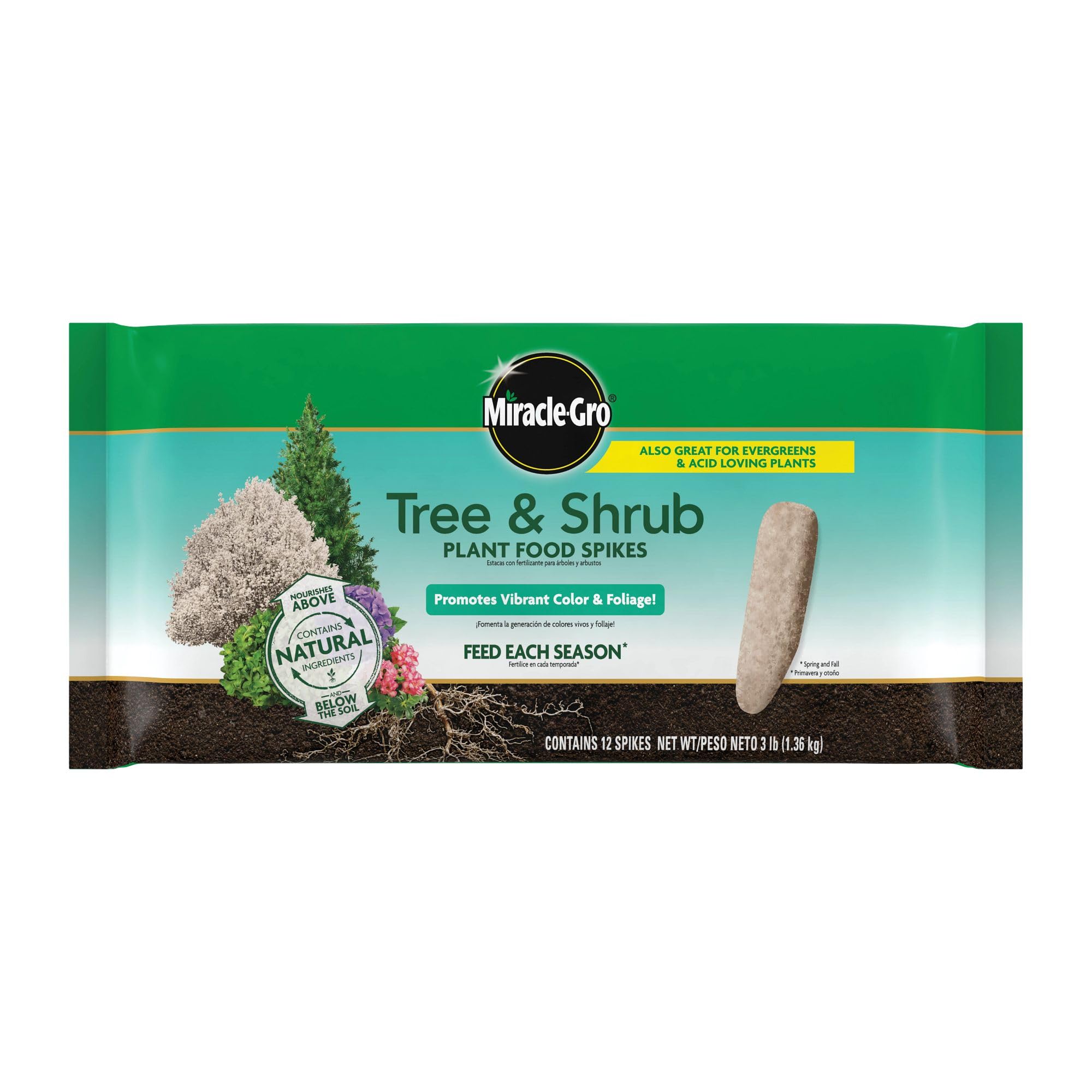
Miracle-Gro Tree 12 Ct

Miracle-Gro Tree 12 Ct

Trees & shrubs

Our Score 9.0/10
Check Price

Worth Noting

  • Spikes can crumble when hammered into hard or rocky soil; plastic caps may snap.
NPK
15-5-10
Count
12 spikes
Target
Deciduous, evergreen, flowering trees, acid-loving plants
Read the full review

The 15-5-10 NPK covers deciduous, evergreen, and acid-loving plants, from oaks to hydrangeas. However, the spikes may break during installation — a pre-drilled hole minimizes the chance of crumbling in dry soil. This pack works best for outdoor tree and shrub beds, not for indoor or houseplant use where the formula would be excessive.

If your soil is dry or compacted, wet it first or drill a pilot hole to reduce the chance of the spike breaking during installation.

Bottom line: A practical choice for outdoor tree and shrub feeding, provided the soil isn't too hard and you're willing to handle the occasional broken spike.

5

Jobe's Fruit & Citrus 6 Ct

Jobe's Fruit & Citrus 6 Ct

Citrus & fruit trees

Our Score 9.0/10
Check Price

Worth Noting

  • Strong manure-like odor can be unpleasant, especially in indoor settings
  • Over-application may cause leaf drop or plant damage; careful dosing required
NPK
3-5-5
Count
6 spikes
Target
Fruit and citrus plants/trees
Read the full review

The 3-5-5 NPK ratio delivers a targeted phosphorus boost that supports flowering and fruit development on citrus and fruit trees. The OMRI-listed organic formulation is easy to insert into pots or ground, but the strong manure-like odor is noticeable, especially indoors. Over-application may cause leaf drop, so dosing needs care. These spikes are best for dedicated citrus and fruit tree growers who can manage the smell and follow spacing instructions.

Insert spikes the recommended distance from the trunk to avoid root burn; use in well-ventilated areas or outdoors to reduce odor.

Bottom line: For citrus and fruit tree owners who want organic feeding, these spikes provide effective nutrition — just plan to use them outdoors and measure spacing carefully.

How to Choose

NPK Ratio: Nitrogen, Phosphorus, Potassium

Each number in the NPK ratio indicates the percentage of nitrogen, phosphorus, and potassium. Nitrogen fuels leafy growth, phosphorus supports blooms and roots, and potassium strengthens overall plant health.

High-nitrogen spikes (e.g., 15-3-3) are ideal for trees and lawns, while high-phosphorus blends (e.g., 6-18-6) boost fruit and flower production. Using a spike with the wrong NPK can lead to lush foliage with few blooms or weak growth.

Number of Spikes and Coverage

Spike count determines how many plants you can feed per package. A 50-pack covers a mixed garden, while 6-pack works for a few trees. Check the coverage instructions: most spikes recommend one per 1-2 inches of trunk diameter or per pot size.

Buying a large pack for a small collection leads to leftover spikes that may degrade over time. For containers, use fewer spikes than for in-ground plants to avoid over-fertilization.

Slow-Release Duration

Fertilizer spikes release nutrients gradually over weeks or months, reducing the need for frequent feeding. Duration varies from 60 days to a full season, depending on formulation and soil moisture.

Faster-release spikes (short duration) require more frequent reapplication but can be adjusted if plants show signs of deficiency. Long-lasting spikes are convenient but make it harder to correct over-fertilization once applied.

Organic vs. Synthetic Formulations

Organic spikes use natural ingredients like bone meal or composted manure and are OMRI-listed for certified organic gardens. They release nutrients more slowly and improve soil microbiology, but often have a distinct manure-like odor.

Synthetic spikes (e.g., Miracle-Gro) provide precise NPK ratios and faster uptake, but do not contribute long-term soil health. They are typically odorless and dissolve more predictably in cold soil.

Target Plant Type

Spikes are formulated for specific plant groups: indoor houseplants, flowering plants, trees, evergreens, or fruit-bearing plants. Using a tree spike on a potted orchid will burn the roots due to high nitrogen concentration.

Some spikes are labelled 'all-purpose' with a balanced NPK (4-4-4), making them safe for most plants but not optimal for any single type. For specialist plants like citrus or azaleas, dedicated formulas deliver better results.

Frequently Asked Questions