Seeds & Plants

11 Best Grass Seed of 2026: Get a Lush Lawn Without the Guesswork

Match grass seed to your lawn's sun, shade, and traffic – not the marketing. Avoid wasted time and money on failed germination.

Spending hours prepping soil and watering every morning only to see bare patches is a familiar frustration. The problem isn't always your technique – often it's the seed itself.

Many top-selling bags bundle fertilizer and soil improver, but added nutrients can't fix old stock or weak genetics. Germination success depends far more on fresh seed and consistent moisture than on how many ingredients are listed on the label.

The right seed for your yard depends on how much sun it gets and how much traffic it endures – not on flashy packaging. This guide matches specific blends to your conditions so you invest in something that will actually grow.

1

JG Black Beauty Ultra 7

Top Pick
JG Black Beauty Ultra 7

Sun to part shade

Our Score 8.6/10
Check Price

Worth Noting

  • Premium price feels expensive if the seed fails to germinate well.
  • Germination can be inconsistent; some batches may not sprout as expected.
Coverage
Overseed up to 2,800 sq ft
Sunlight
Full sun to part shade
Read the full review

This blend combines tall fescue, Kentucky bluegrass, and perennial ryegrass to form a dense turf with roots reaching up to four feet, helping it stay green during dry spells. The result is a dark green lawn that holds color through summer heat without requiring constant watering.

Best suited for homeowners in the transition zone who want a high-quality lawn with reduced watering. Germination success can vary between batches; some bags may not produce uniform growth, so testing a small sample before full application is a sensible precaution.

Consider testing a small amount of seed in a tray of soil before full application to verify batch viability.

Bottom line: For homeowners who prioritize turf quality and are willing to accept some germination risk, this seed delivers the best color and drought tolerance in its class.

2

Scotts High Traffic 5.6

Scotts High Traffic 5.6

High traffic lawns

Our Score 8.6/10
Check Price

Worth Noting

  • Needs more frequent watering than standard mixes to germinate well
  • Premium price feels steep when results vary
Coverage
Overseed up to 2,800 sq ft
Sunlight
Full sun to light shade
Read the full review

This blend is designed for lawns that see constant foot traffic from kids, pets, and play. The self-repairing genetics help grass recover from wear without thinning, and the built-in root nutrition supports regrowth. Compared to the top pick (Jonathan Green Black Beauty Ultra), germination is less consistent, especially in hot weather, and success depends heavily on watering discipline. It is a good match for households with children or dogs who use the yard daily, but the watering requirement makes it less forgiving for casual overseeding.

Keep soil moist daily for the first few weeks — this mix tolerates heat poorly during germination.

Bottom line: Choose this for active yards where durability matters, but only if you are willing to water consistently during establishment.

3

JG Dense Shade 25lb

JG Dense Shade 25lb

Dense shade areas

Our Score 8.6/10
Check Price

Worth Noting

  • Germination is slow (14–21 days) and may fail without consistent moisture
  • Premium price and may thin out after a couple of seasons in tough conditions
Coverage
Overseed up to 15,000 sq ft
Sunlight
Partial sun to dense shade
Read the full review

Jonathan Green Black Beauty Dense Shade is designed for areas with less than four hours of direct sun, making it a targeted solution for tree canopies and building shadows. Germination takes 14 to 21 days, so patience is required. The price is premium, but for shaded zones where other seeds have struggled, the dark green coverage justifies the cost. Durability over multiple seasons may not match sun-tolerant blends, but annual overseeding helps maintain density. Best suited for homeowners with large shaded areas who have had limited success with generic mixes.

Overseed shaded areas annually to maintain thickness, especially in high-traffic zones.

Bottom line: For dense shade that defeats other seed blends, this mix delivers – if you accept the slower establishment and higher upfront cost.

4

Scotts Dense Shade 5.6

Scotts Dense Shade 5.6

Budget dense shade

Our Score 8.6/10
Check Price

Worth Noting

  • Germination rate can be low, requiring heavier seeding to achieve coverage
Coverage
Overseed up to 1,400 sq ft
Sunlight
Grows with 3 hours sun
Read the full review

This mix is effective under dense tree canopies where other grass seeds struggle, thanks to its shade-adapted varieties. However, germination consistency falls short of premium competitors like Jonathan Green's dense shade mix, meaning you may need to overseed more heavily and accept a longer wait for results. Best suited as a budget-friendly option for supplementing shaded patches rather than a primary lawn solution.

Bottom line: A practical supplement for dense shade spots when you're on a budget, but not the most reliable choice for a full-shade lawn renovation.

5

Scotts EZ Seed 20lb

Scotts EZ Seed 20lb

Small patch repair

Our Score 8.4/10
Check Price

Worth Noting

  • Premium price per square foot - not economical for patches larger than a few square feet.
  • Growth can be uneven when applied to larger bare areas.
Coverage
Up to 445 sq ft patch
Sunlight
Full sun to dense shade
Read the full review

This all-in-one system combines mulch, tackifier, and seed to fix small bare spots without extra prep. Germination is often visible within about a week, making it effective for quick patch jobs in mid-summer. It works in sun to shade, and the tackifier holds seed in place on slopes. The cost per square foot runs high, so it suits homeowners fixing isolated patches rather than renovating large areas. Best for beginners or anyone wanting a foolproof spot treatment without measuring or mixing.

Keep the patch consistently moist for the first two weeks to maximize germination.

Bottom line: Best for quick spot repairs where convenience matters more than cost - not for whole-lawn projects.

6

JG Fast Grow 7lb

JG Fast Grow 7lb

Temporary quick cover

Our Score 8.4/10
Check Price

Worth Noting

  • May require overseeding with perennial seed to maintain coverage into a second season
Coverage
Overseed up to 3,500 sq ft
Sunlight
Full sun to moderate shade
Read the full review

Jonathan Green Fast Grow Grass Seed germinates in about a week, providing rapid ground cover on bare soil, slopes, or construction sites. The blend includes annual ryegrass, which completes its life cycle in one growing season – it is not a permanent lawn solution. This product suits homeowners who need quick green for a single season or erosion control, with the understanding that it will need to be replaced with perennial seed for long-term turf.

Plan to overseed with perennial grass seed the following season if you want continued lawn coverage.

Bottom line: A fast, budget-friendly choice for temporary cover, but not a substitute for permanent grass seed.

7

Scotts Sun&Shade 5.6lb

Scotts Sun&Shade 5.6lb

Sun & part shade

Our Score 8.4/10
Check Price

Worth Noting

  • Germination can be unpredictable - some bags may yield no grass even with proper watering.
Coverage
Overseed up to 2,240 sq ft
Sunlight
Full sun to moderate shade
Read the full review

This Scotts mix delivers a lush green color and attractive appearance in sun to moderate shade, with the convenience of fertilizer included. However, germination can be inconsistent - some bags may fail to produce grass even with proper watering. That unpredictability pushes it behind more consistent premium options like Jonathan Green Black Beauty Ultra.

Bottom line: Best for casual overseeding where built-in fertilizer convenience outweighs germination risk.

8

Scotts KY Bluegrass 5.6

Scotts KY Bluegrass 5.6

Full sun bluegrass

Our Score 8.4/10
Check Price

Worth Noting

  • Germination can be spotty
Coverage
Overseed up to 3,730 sq ft
Sunlight
Full sun to light shade
Read the full review

This mix delivers the dark green look typical of Kentucky bluegrass when it takes, and the included fertilizer simplifies seeding. But bluegrass is slow to establish and requires full sun, and germination can be low – so it's best for overseeding sunny, existing bluegrass lawns rather than starting from scratch or shade areas.

Bottom line: Best for homeowners committed to maintaining a traditional bluegrass lawn in full sun who are willing to accept slower establishment and potential re-seeding.

9

Scotts Rapid Sun&Shade 5.6

Scotts Rapid Sun&Shade 5.6

Budget fast germination

Our Score 8.4/10
Check Price

Worth Noting

  • Germination may fail, resulting in no growth
Coverage
Overseed up to 2,800 sq ft
Sunlight
Full sun to shade
Read the full review

This mix germinates fast and produces a vibrant green lawn at a budget-friendly price, but germination failure is possible – success depends on consistent moisture. It suits budget overseeding projects where you accept the risk of needing to reseed.

Bottom line: Best for budget-conscious overseeding where you can water meticulously and accept the possibility of a second application.

10

Pennington Smart 7lb

Pennington Smart 7lb

Cheapest in test

Our Score 8.4/10
Check Price

Worth Noting

  • Germination can be inconsistent - some bags may produce little to no grass.
Coverage
Overseed up to 1,000 sq ft
Sunlight
4–6 hours sun
Read the full review

The lowest price of any seed we tested makes this an option for tight budgets. Some users find it stays green through winter. However, germination can be unreliable, and occasional bags contain weed seeds - better as a cost-stretcher than a standalone solution.

Bottom line: Best for small-area supplementation on a tight budget, but not a primary seed for reliable results.

11

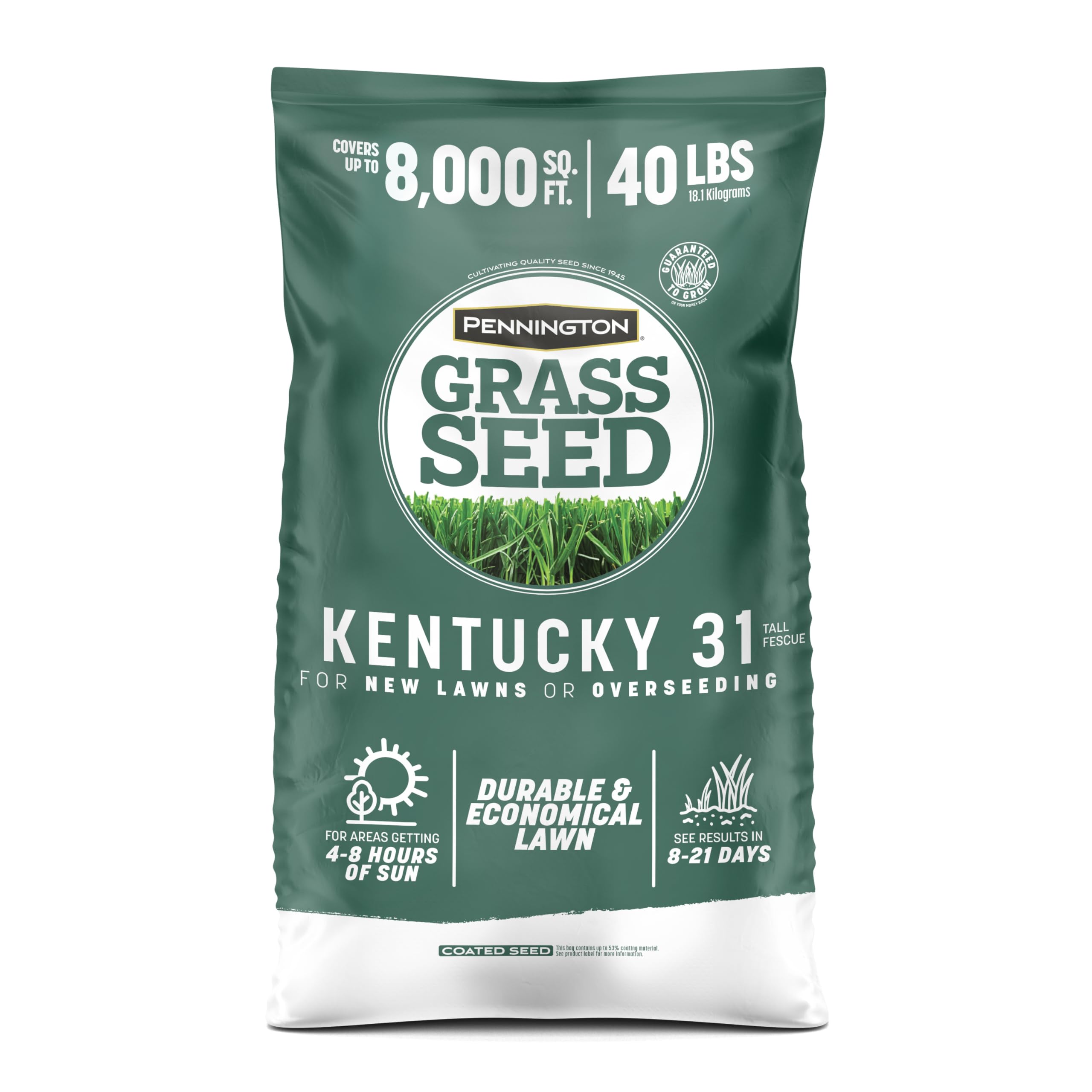
Pennington KY31 40lb

Pennington KY31 40lb

Large area value

Our Score 8.2/10
Check Price

Worth Noting

  • Germination can be minimal or absent in some bags, needing a second attempt.
  • Occasional batches may contain dead seed or weed seeds, reducing effective coverage.
Coverage
Overseed up to 10,000 sq ft
Sunlight
4–8 hours sun
Read the full review

Pennington Kentucky 31 offers the lowest cost per pound in this category, making it an economical choice for covering large acreage with drought-resistant tall fescue. However, germination rates are inconsistent — some bags produce thick turf while others show little to no growth, especially if the seed is older. This seed suits landowners or farmers prioritizing budget over certainty, where overseeding again if the first attempt fails is an acceptable risk. For time-sensitive projects or small yards where wasted seed and water are costly, a more consistent premium seed is a better fit.

Check the bag's production date — fresher seed gives better odds of strong germination.

Bottom line: Pennington Kentucky 31 is a budget choice for large-scale projects where the risk of low germination is manageable. For those needing consistent results, a premium seed is worth the extra cost.

How to Choose

Germination Time

Fast-germinating blends often include annual ryegrass, which dies after one season. Slower mixes (14–21 days) usually contain perennial fescues and bluegrasses that live for years.

A quick green start can be appealing, but if you want a permanent lawn, prioritize seed that takes a bit longer but lasts. Check the label for species – annual ryegrass is temporary.

Sun and Shade Tolerance

Shade-tolerant mixes contain fine fescues that handle low light, but they lack the traffic resistance of tall fescue. Using a sun-and-shade blend under a tree often results in thin, patchy grass.

For areas with less than 4 hours of direct sun, choose a dense shade mix. For full sun, a tall fescue or Kentucky bluegrass blend will give you a thicker, more durable lawn.

Traffic and Drought Resistance

Tall fescue and Kentucky bluegrass are the most wear-tolerant cool-season grasses. High-traffic mixes often add perennial ryegrass for quick self-repair, but they need consistent watering to recover.

Drought resistance comes from deep roots – tall fescue roots can reach 4 feet. However, deep-rooted varieties take longer to establish and may look thin until the second season.

Seed Purity and Weed-Free Guarantee

Cheaper blends frequently contain weed seeds or fillers that germinate alongside your grass. A 99.9% weed-free guarantee costs more but saves you from pulling crabgrass later.

Check the label for a weed seed percentage – anything above 0.5% is risky. Premium brands like Jonathan Green and Scotts Professional offer the cleanest seed.

Coverage Area

Coverage estimates on bags are based on perfect conditions – tilled soil, consistent moisture, and ideal temperatures. In real-world overseeding, expect 20–30% less coverage.

Thinner seeding rates mean more gaps; heavier rates mean more competition for water. For patch repair, you can seed thicker without worry. For new lawns, double the recommended amount if you have patchy soil.

Frequently Asked Questions