Ponds & Water Gardens

5 Best Pond Water Test Kit of 2026: Reliable Ammonia Detection for Healthy Fish

Which pond test kits actually detect ammonia and nitrate? Find reliable options for koi and goldfish ponds that prevent fish loss.

Many pond test strips advertise seven parameters but skip ammonia - the single most important indicator of fish stress. Relying on an incomplete strip can lead to false confidence and, eventually, sick or dead fish. Popular budget brands often hide a critical weakness: their ammonia test pads show zero when dangerous levels exist.

The better path is to know exactly what each kit tests and how accurately. Some strips fail to detect ammonia entirely; others give unreliable pH readings. This guide cuts through the confusion to show which kits are worth your money and which are best left on the shelf.

For any pond with fish, accuracy on ammonia, nitrite, and pH takes priority over convenience. A liquid reagent kit delivers lab-quality results, while a few strip kits can serve as quick check-ins between deeper tests. The right choice depends on your pond's maturity and your tolerance for manual testing.

1

API Pond Master Test Kit

Top Pick
API Pond Master Test Kit

Fish pond accuracy

Our Score 9.2/10
Check Price

Worth Noting

  • Nitrate testing is absent
  • Liquid reagents take more time than dipping a strip, which may feel slow for quick spot checks.
Parameters
pH, Ammonia, Nitrite, Phosphate
Test Count
500+
Test Method
Liquid reagent
Ammonia Test
Yes
Read the full review

Liquid reagent testing gives you precise readings for the four parameters most critical to pond health: pH, ammonia, nitrite, and phosphate. Unlike strip kits that can struggle with ammonia detection, the vial-and-drop method here produces clear, repeatable color changes that match the included cards without guesswork. The 500+ test count means you won't be reordering every month even with weekly checks on a large koi pond.

The tradeoff is that nitrate — the end product of the nitrogen cycle — isn't covered. For ponds with heavy fish loads or newly cycled systems, you'll want to add the separate API Nitrate test kit to complete your monitoring. This kit is best for owners who already understand the basics and want a durable, cost-per-test efficient tool rather than the convenience of dip-and-read strips.

Store the reagent bottles upright and away from direct sunlight to keep the chemicals fresh for the full 500 tests.

Bottom line: For pond owners who prioritize accuracy over speed and need to monitor ammonia, nitrite, and phosphate closely, this kit delivers dependable results at a low per-test cost.
2

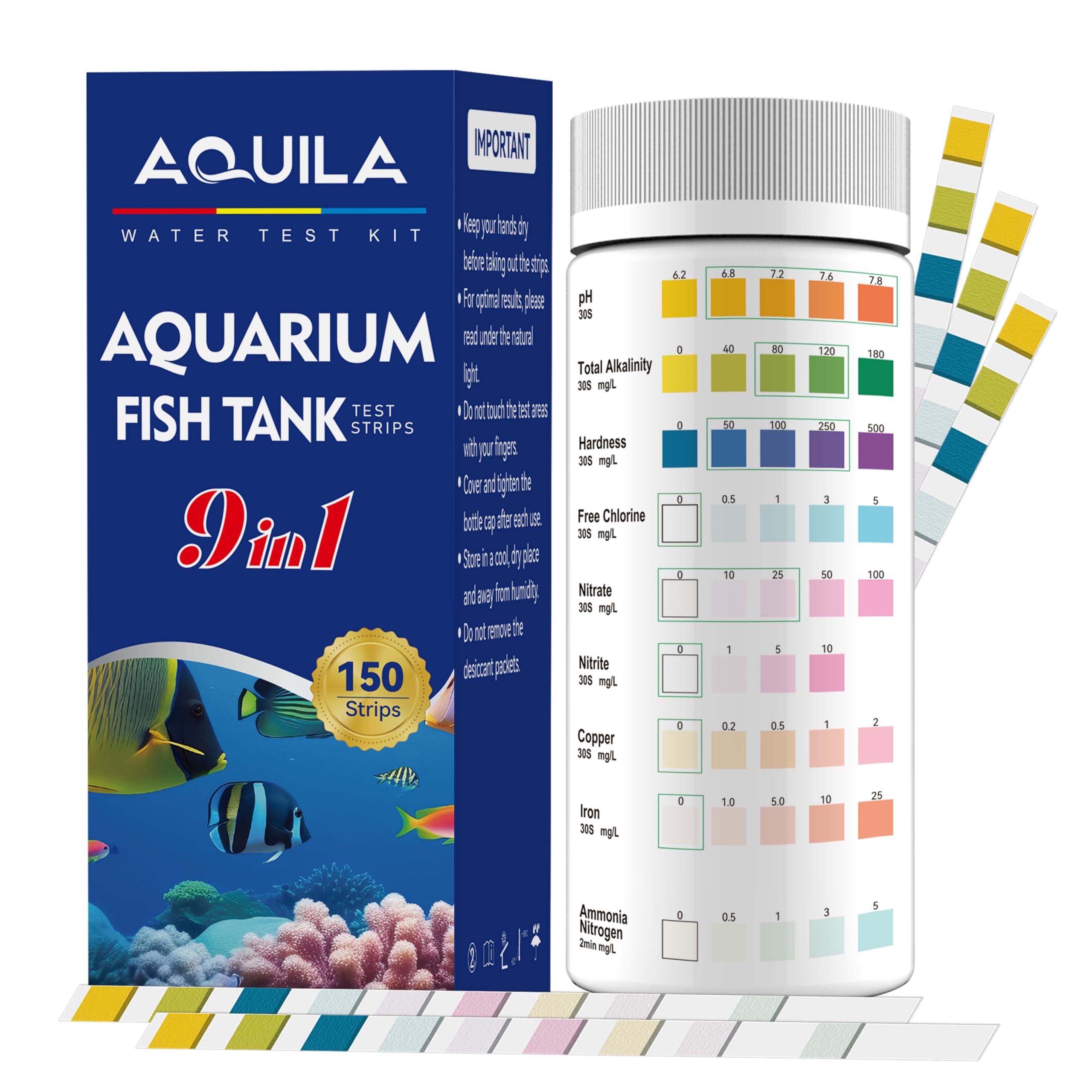
A QUILA 9-in-1 Strips

A QUILA 9-in-1 Strips

Budget frequent test

Our Score 9.0/10
Check Price

Worth Noting

  • Ammonia readings may not always match liquid reagent results
Parameters
pH, Alkalinity, Hardness, Chlorine, Nitrite, Sulfate, Copper, Iron, Ammonia
Test Count
150
Test Method
Dip strips
Ammonia Test
Yes
Read the full review

This dip-and-read strip covers ammonia alongside pH, alkalinity, hardness, chlorine, nitrite, sulfate, copper, and iron – a combination rarely seen at this price point. With 150 strips per bottle, the per-test cost is among the lowest available. For pond keepers who test frequently and want ammonia coverage without the higher expense of liquid kits, this is a practical option, especially if you cross-check critical readings when needed.

Keep a liquid ammonia test kit on hand to validate any questionable strip results.

Bottom line: A cost-effective way to monitor a wide range of pond parameters, including ammonia, when you are willing to verify occasional readings against a liquid test kit for high-stakes situations.

3

API 5-in-1 Pond Strips

API 5-in-1 Pond Strips

Routine monitoring

Our Score 9.0/10
Check Price

Worth Noting

  • Readings may differ from liquid test results, so cross-check critical measurements.
  • No ammonia detection means you'll need a separate liquid ammonia kit for complete water quality monitoring.
Parameters
pH, Nitrite, Nitrate, Carbonate, General Hardness
Test Count
25
Test Method
Dip strips
Ammonia Test
No
Read the full review

Dip-and-read in seconds to check pH, nitrite, nitrate, and hardness – faster than liquid tests for routine pond monitoring. The strips hold up well in damp conditions and color pads remain readable. Best for owners who already have a liquid ammonia kit, since these strips don't test ammonia or phosphate. With only 25 strips per bottle, it suits seasonal use rather than daily tracking.

Pair with a liquid ammonia test kit to cover the missing parameter.

Bottom line: A convenient supplement for pond owners who already have a liquid ammonia and phosphate kit, but not a standalone solution.

4

FUNSWTM 7-in-1 Strips

FUNSWTM 7-in-1 Strips

Quick weekly checks

Our Score 9.0/10
Check Price

Worth Noting

  • No ammonia test
  • pH accuracy can vary; readings may not align with liquid test results
Parameters
Nitrate, Nitrite, Hardness, Chlorine, pH, Carbonate, Alkalinity
Test Count
100
Test Method
Dip strips
Ammonia Test
No
Read the full review

Dipping a strip takes seconds and the large quantity delivers a low per-test cost — handy for weekly monitoring when you just want a snapshot of nitrate, nitrite, hardness, chlorine, pH, carbonate, and alkalinity.

This pack targets owners of stable, established ponds who already run a separate ammonia test. Accuracy varies between strips; pH and other readings may not match liquid test results, so treat the numbers as directional rather than definitive when making water changes or health decisions.

Keep a liquid pH test kit on hand to verify any concerning readings from these strips.

Bottom line: A cost-effective option for routine checks of a mature pond, as long as you have a separate ammonia test and don't rely on the pH reading for critical decisions.

5

AQUAVERITY 7-in-1 Strips

AQUAVERITY 7-in-1 Strips

Experienced owners

Our Score 8.8/10
Check Price

Worth Noting

  • Does not test ammonia, a critical parameter for fish health.
Parameters
pH, Nitrate, Nitrite, Carbonate, Hardness, Chlorine
Test Count
50
Test Method
Dip strips
Ammonia Test
No
Read the full review

The AQUAVERITY 7-in-1 strips measure pH, nitrate, nitrite, carbonate, hardness, and both free and total chlorine at a budget-friendly price per strip. Because real-world accuracy is unverified, these are best suited for experienced pond owners who can act as their own quality check — not for those needing reliable guidance for fish health.

Bottom line: A low-cost strip set for routine checks, but only if ammonia testing is handled separately.

How to Choose

Ammonia Detection

Ammonia is the most toxic waste product in a pond. Even low levels cause gill damage and stress in koi and goldfish. Many strip kits skip this test entirely or include a pad that produces false zeroes.

Liquid reagent kits use a chemical reaction that changes color proportionally to ammonia concentration. This method is far more reliable than the dried reagent pads on strips, which can degrade or react inconsistently.

Test Method

Dip strips are fast and easy: dip, wait, compare colors. But they rely on reading subtle color changes against a printed chart, which varies with lighting and user eyesight.

Liquid reagent tests involve adding drops to a water sample and waiting for a reaction. They take more time but provide more consistent results. Many experienced pond keepers keep both: a liquid kit for regular checks and strips for quick spot-checks.

Test Count

Kits vary from 25 to 500+ tests. If you test weekly, a 25-strip bottle lasts about six months. But if you're troubleshooting a new pond or after a fish loss, you may need multiple tests per week.

The per-test cost of strip kits can be deceiving: a $12 bottle of 100 strips is cheap per test, but if the strips are inaccurate, every test is wasted. Liquid kits have a higher upfront cost but lower per-test cost over time.

Accuracy and Consistency

User reviews reveal a wide gap between average ratings and real-world reliability. A 4.5-star strip can have a 30% chance of giving a wrong reading on pH or ammonia. Always cross-check a new kit's readings against a known accurate liquid test before relying on it.

For critical parameters like ammonia and nitrite, accuracy matters more than convenience.

Parameters Covered

A full pond test should cover pH, ammonia, nitrite, nitrate, and alkalinity. Phosphate is useful for algae control. Some kits also include hardness and chlorine.

More parameters aren't always better if the test pads are unreliable. Focus on a kit that at least covers the nitrogen cycle (ammonia -> nitrite -> nitrate) plus pH. If a kit lacks ammonia, you'll need a separate test.

Frequently Asked Questions