Ponds & Water Gardens

11 Best Pond Water Treatment of 2026: Choose the One Your Fish Survive

Which pond water treatments actually keep koi and goldfish safe? This guide cuts through misleading labels to match your pond's real needs.

Many pond treatments promise fish safety, but hundreds of customer reports tell a different story: algaecides labeled 'safe' have killed fish, and bacterial treatments can smell like rotten eggs. The problem isn't malice — it's a mismatch between the product's intended use and your pond's actual conditions.

This guide focuses on products with verified fish-safe track records, and it calls out the ones that belong only in fishless fountains. You'll find conditioners that make tap water safe, biological clarifiers that reduce muck without drama, and targeted solutions for algae and sludge — each matched to a specific pond problem.

The key is knowing what your pond actually needs: a water change routine, a biological boost, or a chemical intervention. Start with the top pick, then read the selection below to find the right fit for your koi, goldfish, or decorative water feature.

1

API Stress Coat 32oz

Top Pick
API Stress Coat 32oz

Pond maintenance

Our Score 9.6/10
Check Price

Worth Noting

  • Does not treat algae or sludge
Fish Safety
Safe for fish
Treatment Volume
3,840 gal
Active Ingredient
Aloe vera, dechlorinator
Read the full review

API Stress Coat neutralizes tap water chemicals and adds aloe vera to help fish heal from stress, handling up to 3,840 gallons per bottle. The formula preserves water clarity and supports beneficial bacteria, making it a straightforward addition to any pond maintenance routine.

This conditioner fits koi and goldfish keepers who perform regular water changes or set up new ponds. It does not treat algae or sludge, so ponds with those issues need a separate bacteria or clarifier product.

Bottom line: Safe water and stress relief for routine pond care — pair with a bacteria treatment for full algae and sludge control.

2

Seachem Pond Prime 2L

Seachem Pond Prime 2L

Large pond conditioner

Our Score 9.6/10
Check Price

Worth Noting

  • Noticeable sulfur-like odor when dosing
Fish Safety
Safe for fish
Treatment Volume
20,000 gal/L
Active Ingredient
Dechlorinator, ammonia detox
Read the full review

This ultra-concentrated conditioner treats 20,000 gallons per liter, making it a cost-effective option for large ponds. The premium upfront cost and noticeable sulfur-like odor during use limit its appeal to owners who prioritize value over smell and have the space to accommodate a big bottle.

Bottom line: Best suited for ponds above 5,000 gallons where the concentration justifies the premium price and the sulfur odor is not a dealbreaker.

3

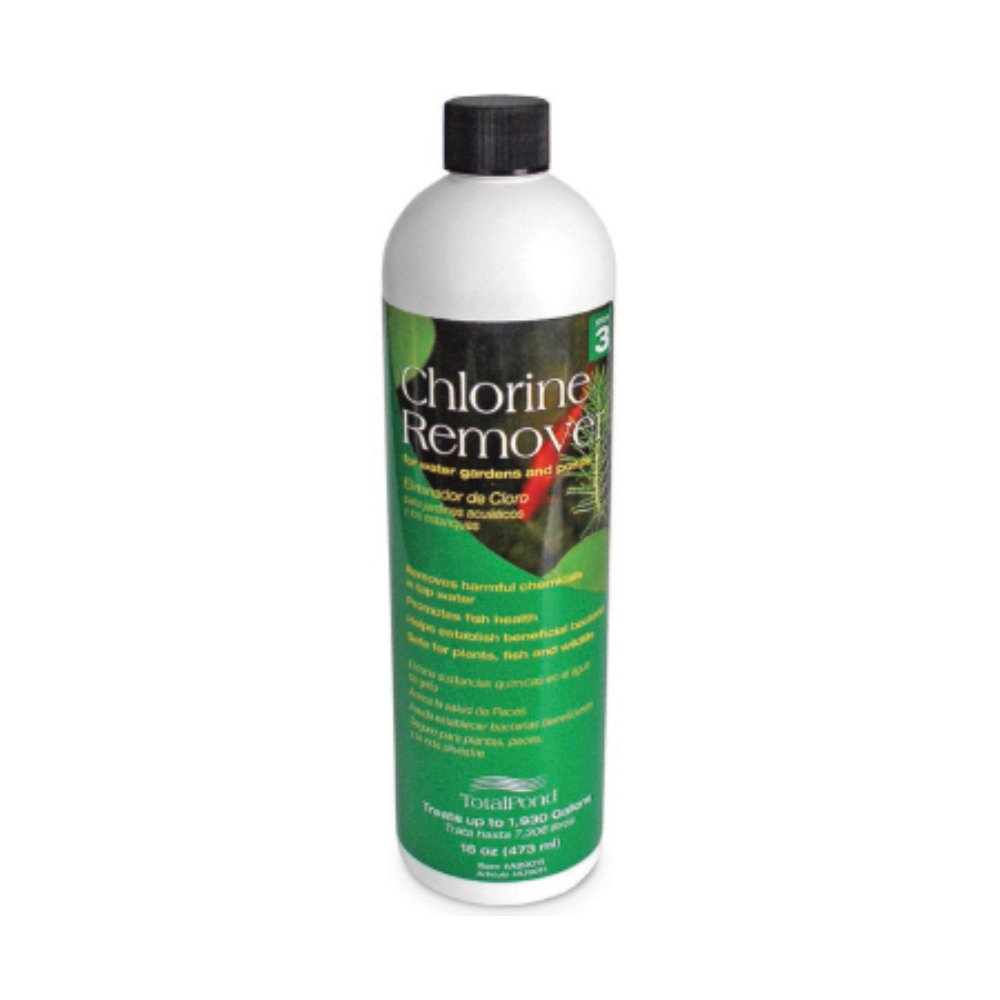
TotalPond Chlorine Remover 16oz

TotalPond Chlorine Remover 16oz

Dechlorination

Our Score 9.2/10
Check Price

Worth Noting

  • Only handles chlorine and chloramine
Fish Safety
Safe for fish
Treatment Volume
1,920 gal
Active Ingredient
Chlorine/chloramine remover
Read the full review

TotalPond A20011 Chlorine Remover Plus strips chlorine and chloramine from tap water at a per-gallon cost that is hard to beat – treating up to 1,920 gallons from a 16-ounce bottle. This is a basic dechlorinator with no frills: no aloe vera slime coat, no ammonia binders, no algae control. It is best suited to small ponds where the primary concern is making tap water safe during water changes or emergency top-offs. For ponds needing multi-purpose conditioning or additional treatment, the API Stress Coat covers more ground.

Bottom line: A cost-effective chlorine remover for small pond owners who need one thing done well – keep expectations limited to that single task.

4

Airmax Pond Dye 1Gal

Airmax Pond Dye 1Gal

Large pond algae

Our Score 9.2/10
Check Price

Worth Noting

  • Potential staining of hands, clothes, and surfaces if dye is spilled.
  • Some ponds may not achieve the expected blue color depending on water chemistry and dosage.
Fish Safety
Safe for fish
Treatment Volume
1 surface acre
Active Ingredient
Dye, beneficial bacteria
Read the full review

Combines sun-blocking dye with beneficial bacteria to improve water clarity and reduce weed growth, giving large decorative ponds a natural blue tint while suppressing algae. Unlike basic dyes, the bacteria component helps break down organic waste. This formula is designed for ponds up to one acre and is safe for fish and wildlife. The premium price reflects the dual action, and care is needed to avoid staining surfaces if spilled.

Spills can stain surfaces — handle the gallon jug over grass or concrete and rinse immediately if any spills occur.

Bottom line: For large pond owners seeking both functional algae control and an attractive blue aesthetic, this two-in-one formula delivers — but only if you're comfortable with the premium price and careful spill management.

5

Aquashade Dye 1Gal

Aquashade Dye 1Gal

Large pond dye

Our Score 9.2/10
Check Price

Worth Noting

  • Can stain hands, clothing, and surfaces if spilled.
Fish Safety
Safe for fish
Treatment Volume
1 surface acre
Active Ingredient
Dye
Read the full review

Suppresses algae by shading the water column, which reduces weed growth and gives ponds a natural blue tint. The dye remains visible for weeks. However, it stains hands and surfaces if spilled, and the cost per volume is higher than alternatives like Airmax, making it less economical for ponds under half an acre.

Bottom line: Best for large farm ponds or lakes where algae control and aesthetic color are priorities, and staining can be managed with careful handling.

6

Aquascape Bacteria 1.1lb

Aquascape Bacteria 1.1lb

Biological filtration

Our Score 9.0/10
Check Price

Worth Noting

Fish Safety
Safe for fish
Treatment Volume
104,000 gal
Active Ingredient
8 bacteria strains
Read the full review

This eight-strain bacteria concentrate treats up to 104,000 gallons per container, making it the most economical option for large ponds. It works gradually, digesting sludge and organic waste over days to improve water clarity without harsh chemicals. The formulation includes marigold and vitamin B to support fish health. One note: the jar lid may leak during shipping, so storing upright is recommended. This product is ideal for pond owners with fish and plants who prioritize natural biological balance over instant algae fixes.

Store the jar upright when it arrives - the lid can loosen during shipping.

Bottom line: Best for pond owners who can store the jar upright - the per-gallon cost is unmatched for biological pond maintenance.

7

EasyCare Fountec 64oz

EasyCare Fountec 64oz

Fishless fountains

Our Score 9.0/10
Check Price

Worth Noting

  • Not safe for ponds with fish or aquatic life
Fish Safety
Not fish-safe
Treatment Volume
Not specified
Active Ingredient
Algaecide
Read the full review

EasyCare Fountec clears yellow and black algae quickly in fountains and birdbaths, keeping water crystal clear with a weekly maintenance dose. The concentrated formula requires only a few drops per treatment. However, it is toxic to fish and aquatic life, and the label warns of hazards to humans and domestic animals. This makes it unsuitable for pond owners with fish — a fish-safe conditioner like API Stress Coat is a better foundation for a stocked pond. Fountec is best for decorative water features where no fish or wildlife are present.

Bottom line: Effective for its niche, but pond owners with fish should choose a fish-safe alternative like API Stress Coat.

8

Microbe-Lift PL 16oz

Microbe-Lift PL 16oz

Budget bacteria

Our Score 9.0/10
Check Price

Worth Noting

  • Has a strong sulfur smell during application and storage.
Fish Safety
Safe with caution
Treatment Volume
80 gal for 11 months
Active Ingredient
Bacteria
Read the full review

This bacteria accelerates organic waste breakdown and helps control algae at a budget-friendly price. However, the strong sulfur-like odor when applying and occasional fish loss reports mean it suits pond owners who can tolerate the smell and don't keep high-value fish.

Bottom line: A budget-friendly choice for pond owners who prioritize cost over convenience and don't keep prize fish.

9

Sanco Algaecide 8oz

Sanco Algaecide 8oz

Fishless fountains

Our Score 8.8/10
Check Price

Worth Noting

  • The chemical formula can be hazardous to humans and pets; not safe for ponds with fish.
Fish Safety
Not fish-safe
Treatment Volume
8,000 gal
Active Ingredient
Algaecide
Read the full review

Sanco's algaecide clears green water and string algae quickly in fountains and birdbaths without fish. However, the strong chemical formula is hazardous to humans and pets, limiting where it can be used safely. This, along with mixed feedback on value, makes the top-selling fountain algaecide a more reliable choice for most buyers.

Bottom line: A budget-friendly option for fishless fountains and birdbaths where safety precautions are strictly followed.

10

API Pond-Zyme 1lb

API Pond-Zyme 1lb

Sludge removal

Our Score 8.6/10
Check Price

Worth Noting

  • Oxygen demand from bacteria activity may cause fish stress or loss in poorly aerated ponds
  • Some users consider the price high for the gradual results it delivers
Fish Safety
Safe with caution
Treatment Volume
Not specified
Active Ingredient
Bacteria, barley
Read the full review

Unlike general water conditioners like API Stress Coat, this product targets the muck that builds up at the bottom of your pond. The barley and bacteria blend works over weeks to break down organic waste, improving clarity as sludge is reduced. Fish loss has been noted in some cases, particularly with heavy organic loads or warm water; keeping the pond aerated helps manage the risk. This is a maintenance tool for preventing seasonal buildup, not a quick fix for murky water.

Best suited for ponds with leaves, fish waste, or dead algae accumulation where you can monitor oxygen levels. Avoid if you have very sensitive fish species or need immediate water clarity improvement.

Maintain good aeration during treatment, especially in warm weather, to keep oxygen levels stable.

Bottom line: A practical sludge-management tool for pond owners who can provide aeration and accept gradual results — not a solution for sensitive fish or instant clarity.

11

Summit Barley Straw 2pk

Summit Barley Straw 2pk

Natural algae control

Our Score 8.4/10
Check Price

Worth Noting

  • Bales can sink within days and the netting may tear, reducing effectiveness unless floated
  • Algae suppression results vary
Fish Safety
Safe for fish
Treatment Volume
1,000 gal per bale
Active Ingredient
Barley straw
Read the full review

For under $11, this two-pack of barley straw bales offers a chemical-free algae reduction method safe for fish and plants. It works slowly, releasing natural compounds over 3–4 weeks. Effectiveness varies widely – some ponds clear up, others see no change. Best for patient, eco-conscious owners with small ponds who can keep the bales afloat.

Float the bales in a mesh bag or ring to keep them near the surface and prevent sinking.

Bottom line: The cheapest natural option for small ponds, but inconsistent results and handling quirks make it a gamble for impatient owners.

How to Choose

Fish Safety

The most critical spec is whether the product is safe for fish, frogs, and plants. Many algaecides and clarifiers carry labels that claim safety but customer reviews reveal fish kills. The distinction is often between 'safe when used as directed' and 'safe for fish' — and dosing mistakes or oxygen depletion turn chemical algaecides into poison.

For ponds with koi or goldfish, choose conditioners with a proven track record and bacterial treatments that work biologically rather than chemically. If the label says 'do not use with fish' or lists hazard warnings, take it seriously.

Treatment Volume

The volume a product can treat determines how often you'll need to buy more. Concentrated conditioners like Seachem Pond Prime treat 20,000 gallons per liter, while budget options may cover only a few hundred gallons. For large farm ponds, a higher upfront cost saves money over time. For small garden ponds, a smaller bottle avoids waste and spoilage.

Always calculate your pond's actual volume (length x width x depth x 7.5) to match the product's coverage. Overdosing can harm fish, especially with algaecides and heavy chemical conditioners.

Active Ingredient

The active ingredient determines what the product actually does. Dechlorinators (sodium thiosulfate, aloe vera) neutralize chlorine and chloramine. Bacterial blends (Bacillus, Pseudomonas) consume excess nutrients and organic waste. Dyes (copper-free) block sunlight to prevent algae. Algaecides (copper-based or synthetic) kill algae directly but carry higher risk to aquatic life.

Choose based on your primary problem: chlorine from tap water, green water from nutrient imbalance, sludge from decaying matter, or persistent weed growth. A single product cannot solve all of these.

Concentration

Concentration is often hidden in the dosing instructions. A product that requires capfuls per 100 gallons may look cheap but costs more per treatment than one that uses drops. Highly concentrated treatments, like Seachem Pond Prime or API Chlorine Neutralizer, offer better long-term value for large ponds. Budget products with low concentration may be sufficient for small water features or emergency use.

Check the 'treats up to X gallons' number on the label, and divide the price by the total gallons treated to compare real cost per gallon. A $60 bottle treating 20,000 gallons is cheaper than a $10 bottle treating 500 gallons.

Application Frequency

Some treatments are one-time applications (dyes, barley straw bales) while others require weekly or biweekly dosing (bacteria, clarifiers). Choose based on your willingness to maintain a routine. Busy pond owners may prefer a long-lasting dye or slow-release barley straw, while those with small ponds can handle weekly bacteria doses. Algaecides often need reapplication after rain or heavy algae blooms.

If you travel frequently, avoid products that require strict weekly schedules. A missed dose can cause a crash in water quality, especially with bacterial treatments that rely on consistent aerobic conditions.

Frequently Asked Questions