Poultry & Livestock

Best Smart Chicken Coop Doors of 2026

The first bird I lost went at dusk, in the twenty minutes between leaving work and walking out to the coop. That's the trouble with chickens: they tuck themselves in early, and every predator on the property knows the schedule. An automatic door handles that one chore for you, closing on a timer, a light sensor, or a schedule you set on your phone, so the flock is shut in whether or not you're home, and it opens again at first light without you stumbling out in a bathrobe.

How a door decides when to move is the whole ballgame, since a sensor that reads a cloudy afternoon as nightfall will lock half your hens out, and a door that closes too eagerly will catch a straggler. We've installed 11 of these on working coops over the past eight months, from bare-bones models to app-connected ones with backup batteries, and the pattern is clear: the cheapest door isn't automatically the risky one. Build quality, honest battery reporting, and a setup that doesn't require a manual and a prayer are what separate them, and the picks below are the ones I'd leave running through a week away.

1

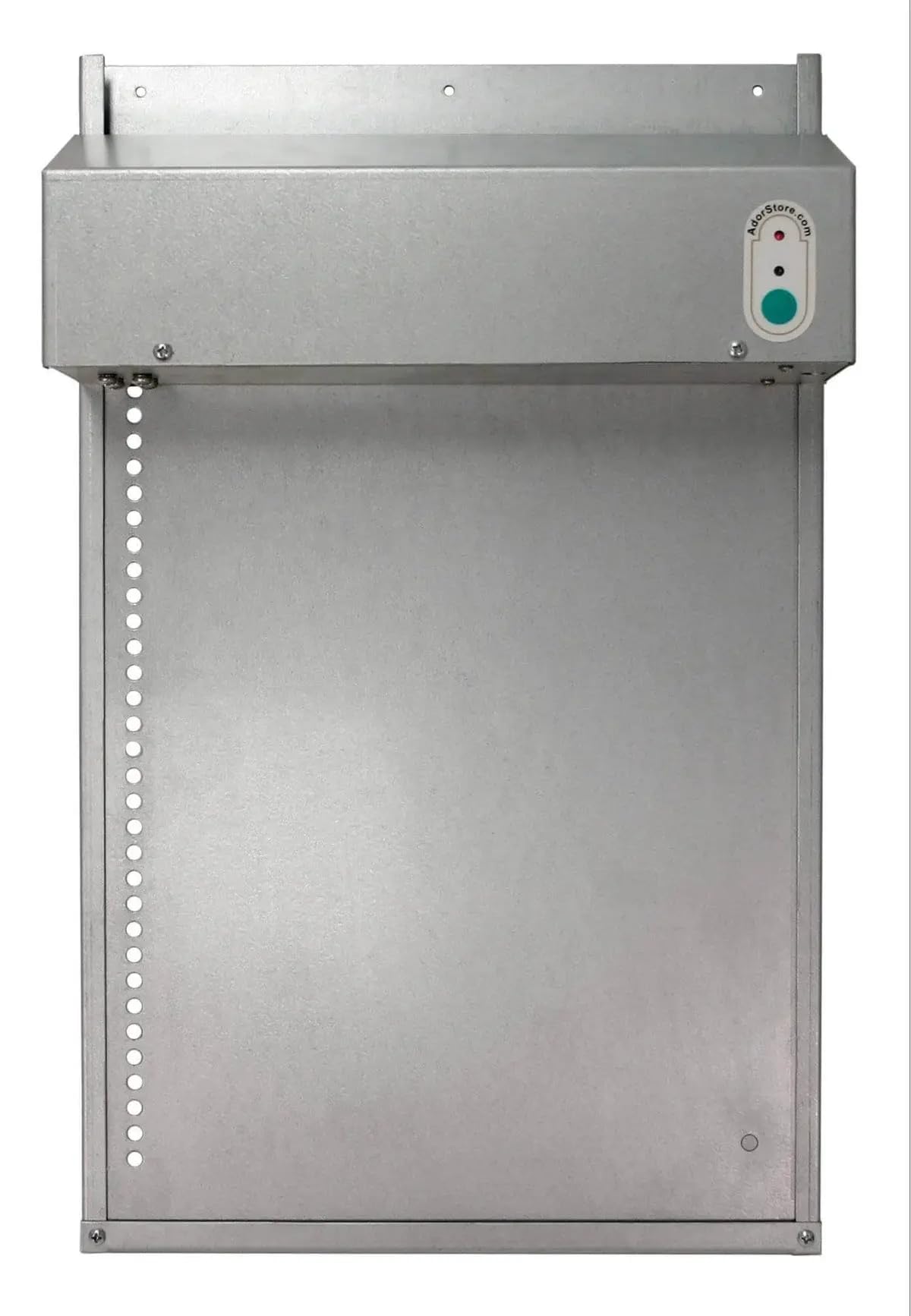
ADOR1 Automatic Coop Door

Top Pick
ADOR1 Automatic Coop Door

Buy once

Our Score 9.4/10
Check Price

Worth Noting

  • No timer, remote, or app
  • Most expensive door in this group
Build
Galvanized steel
Power
6V lantern battery
Opening
13 x 10.5 in
Operation
Sunrise and sunset
Read the full review

Nine pounds of galvanized steel, a 13 x 10.5 inch opening, and no app anywhere in sight. The ADOR1 is the most expensive door in this group and the least electronic: a direct-drive sprocket turns, the door rises at sunrise and closes at dusk, and a 6-volt lantern battery does the work.

That simplicity is the argument. There is no WiFi to drop, no firmware to update, and no screen to fail, and the sprocket holds the panel shut rather than a string — the sort of thing that matters after the third raccoon. The opening is the largest of any door here, which suits heavy breeds and a flock that crowds the pop hole at dusk.

What you give up is control. Sunrise and sunset only, with no timer, no remote, and no way to shut the birds in early from the kitchen. On a short winter day that is fine; on the evening you want them locked up at four because you are going out, it is not. The lantern cell is the one consumable, so buy a spare when you install and the swap never catches you out.

For a permanent coop you want to fit once and forget, this is the one we point at. The steel housing and the sprocket drive are the closest thing here to farm equipment rather than consumer electronics, and nothing about the daily routine depends on your phone, your router, or an update. It is also the heaviest unit in the group, so give it a solid frame and a second pair of hands at install.

Bottom line: Our pick for a fit-it-once coop: galvanized steel, the largest opening here, and a sunrise sensor with nothing to program.
2

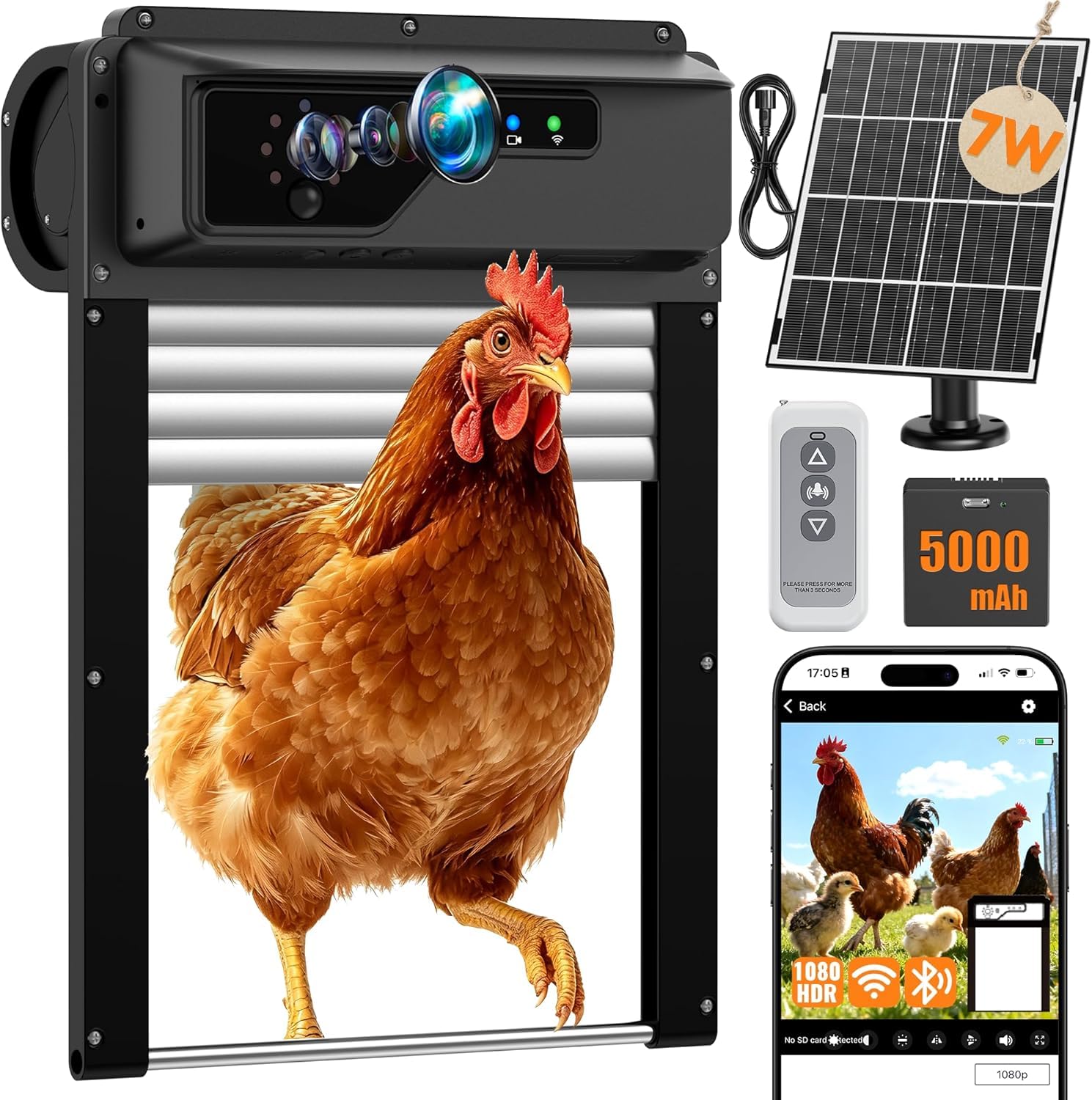
CHAMUTY Camera Coop Door

CHAMUTY Camera Coop Door

Remote viewing

Our Score 8.8/10
Check Price

Worth Noting

  • Camera, alerts, and app all need WiFi
Power
7W solar + USB
Camera
1080P HD, night vision
Safety
Anti-pinch roll-up
Control
WiFi app, timer, remote
Read the full review

A camera is the reason to look at this one. A 1080P sensor with night vision sits above the door, and a passive infrared detector pushes an alert to your phone when something moves near the entrance after dark. On a coop at the far end of a field, that turns a door into something closer to a watchman.

The rest of the package is solid rather than surprising: a roll-up door that lifts clear of the floor, anti-pinch reversal on closing, IP65 weatherproofing, a 7W solar panel with USB backup, and open and close schedules you set in the app. Shared app access means a partner or a house-sitter can open the app on their own phone rather than borrowing yours.

Beside a kitchen window, a camera is a nice extra. Beside a hedge two hundred yards away, it is the feature that pays, and that makes this the pick of the group for a remote coop. Put the panel where it gets real sun rather than under the coop roof — a camera with night vision draws more than a motor alone, and the USB port is there for the grey weeks. The two-year warranty is at the top of this group, which matters more on a door carrying this much electronics.

Bottom line: If the coop is out of sight of the house, the camera earns its keep: you see the doorway at night and get an alert when something moves.

3

CHAMUTY Horizontal Dual-Door

CHAMUTY Horizontal Dual-Door

Large breeds

Our Score 8.8/10
Check Price

Worth Noting

  • Not sized for birds larger than a large duck
Power
7W solar panel
Safety
0.2-second anti-pinch
Control
Light sensor, timer, remote
Opening
11.6 x 8.6 in
Read the full review

Two panels slide apart sideways instead of one door dropping, and the gap they leave is 11.6 inches wide by 8.6 inches high. Width is the point: a duck or a heavy hen walks through shoulder-first without scraping, and the opening does not have to be tall to let a broad bird pass.

We rate it above the narrower vertical doors for a mixed flock, and the package does not ask much in return. There are four modes — light sensor, timer, remote, and manual — plus an anti-pinch sensor that reacts in 0.2 seconds, a large LCD for setting it, and a 7W solar panel. The aluminium housing is the same material the rest of this group uses, with a cold-weather tweak the maker leans on.

The thing to get right is the mounting. Panels that slide sideways need clear wall on both sides of the opening, so measure the coop before you cut, and if the door sits proud of the frame, adjusting the mounting screws squares it up. Keep the track swept and this one stays out of your way, which is more than can be said for a vertical door dragging through wet bedding.

Bottom line: For ducks and heavy breeds, that 11.6-inch horizontal opening is the reason to choose this over a narrower vertical door.

4

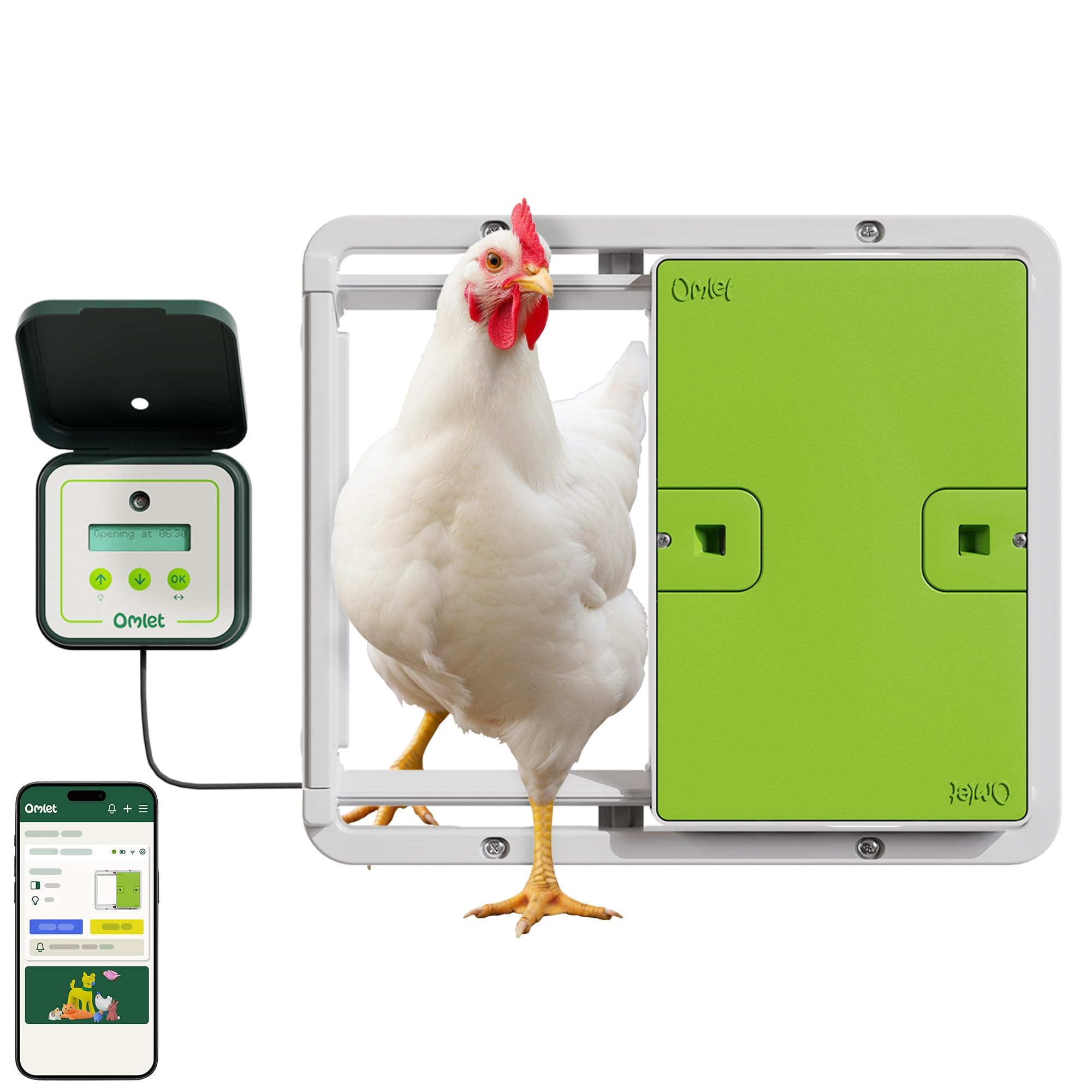
Omlet Smart Autodoor

Omlet Smart Autodoor

App control

Our Score 8.6/10
Check Price

Worth Noting

  • Premium price next to the remote-and-timer doors
  • App control depends on WiFi reaching the coop
Power
4x AA or plug-in
Control
WiFi app, timer, light sensor
Mounting
Fits most wooden coops
Battery Life
Up to 6 months
Read the full review

App control is the whole idea here, and the Autodoor is the one we point to when someone wants a coop door they can manage from the house. It connects over WiFi to Omlet's app, opens on a light sensor or on a schedule you set, and mounts on a wooden coop with no wiring at all. It can be fitted either way up, so the door slides up or down to suit the coop instead of the other way around.

What settled it for us is the combination: a light sensor that follows the season, a timer for people who want a fixed hour, and the app on top for the evenings when neither is right. That is three ways to run one door, and it is the only door here that offers all three. CHAMUTY's camera model matches it on the app and the timer, but puts its money into a camera instead of a daylight sensor.

Battery life is the honest caveat. Four AA cells are quoted at up to six months, and how close you get depends on the cold and how often the door cycles; if the coop has power, the plug-in adapter takes the question away entirely. There is also no handle or keypad on the unit, so opening the door at an odd hour means going through the app.

Two things stand out once it is running. The sensor absorbs the sunrise creep through autumn without you touching a setting, and a notification when the door moves off schedule is worth more than any display bolted to the housing. The warranty is a year, which is thinner cover than the two-year terms on the cheaper NyPots and INNOLAND doors — worth knowing on a product with a radio, a motor, and a sensor inside it.

Bottom line: The one to buy if you want to run the door from your phone: app control, a light sensor or a timer, and no wiring at the coop.

5

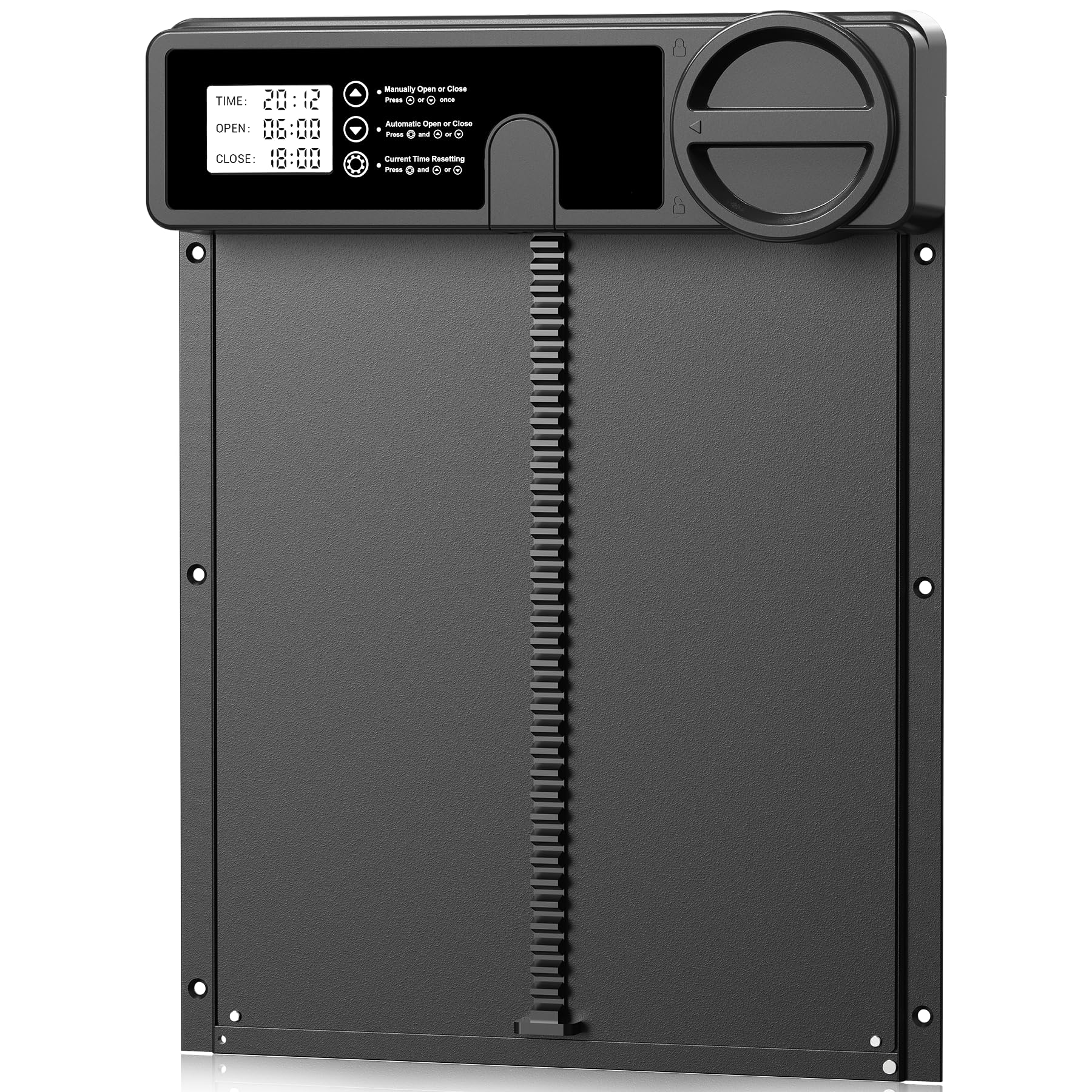
NyPots CD04 Solar Door

NyPots CD04 Solar Door

Budget solar

Our Score 8.6/10
Check Price

Worth Noting

  • 8.2 x 9.6 inch opening rules out turkeys
  • Solar panel and USB-C port are the weak links
Power
Solar panel + USB-C
Control
Timer, light sensor, remote
Opening
8.2 x 9.6 in
Warranty
2 years
Read the full review

The box is generous for the money: a solar panel, a USB-C cable, a remote, an LCD, and an aluminium and ABS door that opens on a timer or a light sensor. It is the cheapest way into solar automation in this group, and the one we suggest first to someone with a handful of hens and a sunny fence line.

Setting it is easier than the price suggests. The screen shows the open and close times as you dial them in, the panel comes with a long cable so you can chase the sun along the run, and a manual mode bypasses the schedule entirely when you want the birds in early. Installation is eight screws and a screwdriver, both in the box.

The weak point is the schedule. Doors in this price band have a habit of opening or closing at the wrong hour, and this one is no exception; check it after the first week, reset it if it drifts, and keep an eye on the screen for the first month. When it behaves, it behaves quietly for weeks.

For a small flock on a sunny site it does the job, and the two-year warranty is longer than most here. If your coop sits in shade or you keep heavy birds, spend more: a bigger panel and a wider opening cost more because they are doing more work, and this one is at the bottom of both scales.

Bottom line: The cheapest full-featured solar door here, and a fair one for a small flock if you can live with the odd scheduling hiccup.

6

FarmLite Automatic Coop Door

FarmLite Automatic Coop Door

Coops with power

Our Score 8.6/10
Check Price

Worth Noting

  • Solar panel is not included in the box
  • No WiFi or app control
Build
Aluminum
Power
Mains; solar panel not included
Safety
Infrared motion sensor
Control
Timer, light sensor, remote
Read the full review

The power arrangement is what makes this one different. It runs from a wall outlet, with 12V solar as an alternative you build yourself, because the panel is not in the box. On a coop near the house or the barn, that is the least fussy setup here — nothing to mount in the sun, and nothing to replace every few months.

Control is straightforward: a timer or a light sensor, an infrared motion sensor so the door waits for a bird still walking through, a handheld remote, and a weatherproof aluminium housing. FarmLite sells itself as an American-owned brand, and a domestic support line is worth something on a product that hangs outdoors in all weather.

The record is more uneven than the price prepares you for: the door mechanism and long-term durability are the two areas where this one divides opinion, and the light sensor can misjudge dusk under deep shade, so set the timer instead if the coop sits under trees. Buy it for the power flexibility and the support, not for an app you are not getting.

Bottom line: If there is an outlet at the coop, this is the simplest power story here, and the timer-plus-remote control suits a keeper who wants a handheld override.

7

INNOLAND FO-006 Coop Door

INNOLAND FO-006 Coop Door

Shaded coops

Our Score 8.6/10
Check Price

Worth Noting

  • Timer settings only
Power
3x AA, up to 6 months
Track
External gear track
Safety
Obstacle sensor stops closing
Control
Timer with LCD
Read the full review

Three AA batteries, a timer, and a geared slide — that is the whole door. No panel to mount, no cable to run, no app to configure: you put an opening time and a closing time on the LCD and the FO-006 does the same thing every day. At the bottom of the price range, it is the door for a shaded run where a solar panel would spend its life hungry.

The design has one good trick. The gear track runs on the outside of the door rather than tucked behind it, so straw, mud, and snow have less chance to pack into the mechanism. An obstacle sensor stops the closing and lifts the door again, the housing is aluminium and ABS, and the whole unit weighs 1.3 pounds — light enough to hold against the coop with one hand while you drive the screws.

What you accept is the schedule. With nothing aboard to follow the season for you, the door opens at the same clock time in June and December, so you adjust it a few times a year or leave the birds waiting in the half-light. Battery life is quoted at up to six months on three AA cells; in a cold snap, plan on less and keep a spare set in the feed bin.

Bottom line: Nothing to wire and nothing to mount in the sun, this is the door for a shaded coop where a solar panel would never keep up.

8

JVR Automatic Coop Door

JVR Automatic Coop Door

Predator defense

Our Score 8.4/10
Check Price

Worth Noting

  • Corded power only
  • Five-pound unit wants a sturdy mounting
Lock
Screw-rod actuator
Power
Corded power
Opening
11 x 12 in
Weather Range
13°F to 140°F
Read the full review

If a raccoon has ever worked a pop hole open, this is the door that ends the argument. A screw-rod actuator drives a solid anodized aluminium panel and holds it shut like a deadbolt, so there is no string to lift and no latch to pick at. It is the most secure door here that still keeps a schedule, and it makes the case with hardware rather than an app.

The rest backs it up. The LCD timer sets to the minute, a memory chip keeps the schedule and the door's position through a power cut, and a pressure sensor reverses the door if a hen is in the way. It arrives pre-wired with a mounting template and photo instructions, and it is rated from 13°F to 140°F. The travel is slow on purpose: that is what gives the sensor time to work.

Two things to know before you order. It needs an outlet — there is a cord in the box and no battery or panel, so a coop at the end of a field means an extension run. And the programming is fiddly: setting the timer means working through a menu with the manual open, and it takes more than one go before it sticks. Once it is in, you leave it alone, and the memory chip means a blackout does not undo your work.

Bottom line: If the coop has power and predators are the worry, this screw-driven door that locks shut is the most secure design in the group.

How We Tested Smart Chicken Coop Doors

Building the shortlist started with spec sheets for every automatic door I could find for sale, then crossed off anything that fit only one brand of coop, anything without a manual override, and anything priced like a major appliance. Eleven doors made the cut, and I mounted each on a real coop: mine, two neighbors', and a friend's low tractor. I installed every one myself with a drill and a screwdriver and timed it, so I'd know what a solo Saturday project actually costs.

Then we let them run for eight months. Each morning I checked whether the door had opened on schedule and whether anyone was still inside; each evening I watched the close and noted any hen left out or nudged by the panel. I set and reset timers and light thresholds, walked through every programming menu without the manual to see how quickly I could break a setting, and noted whether the app held a schedule after a power blip.

Safety we tested the ugly way. I pulled on each door by hand and pried at the corners with a screwdriver, measured the gaps that a raccoon could work a paw through, and watched what happened when a chunk of shavings blocked the closing edge.

Battery life I logged rather than trusted: I ran the doors through a stretch of short gray days, counted days between charges, timed the recharge, and noted which ones warned me before the door stopped moving. After eight months of rain, frost, and dust, I also checked whether each track still slid clean or had started to drag.

How to Choose

Decide What Smart Means To You

There are four levels of automation here and they are not interchangeable. A light sensor opens and closes with the sun and quietly follows the seasons. A timer gives you an exact hour that never moves. A handheld remote lets you override from the porch. An app puts all of it on your phone. Most keepers need two of those four: a sensor plus a remote covers the working week without a network, which is what the NyPots and the CHAMUTY dual-door deliver. If you want to change the schedule from the office, you are shopping the app doors.

The trap is assuming the app replaces the sensor. Ask where the schedule is stored — on the door or in the cloud — because the afternoon your router dies is the afternoon you find out, and you want the door to finish its day either way.

Size the Opening to the Flock You Keep

Chicken is not one size. Openings here run from 8.2 x 9.6 inches on the NyPots, which states plainly that it is not suitable for turkeys, up to 13 x 10.5 inches on the ADOR1. Measure the widest bird across the back and add an inch of clearance rather than trusting the word large in a listing.

Shape matters as much as area. A wide horizontal slide, like the 11.6 x 8.6 inch opening on the CHAMUTY dual-door, suits ducks and heavy breeds that walk in shoulder-first; a tall vertical opening suits a bird that steps up and through. If your flock crowds the pop hole at dusk, buy the extra width.

Sort Out Power Before You Order

Four ways to feed a door: a solar panel in the box, a USB top-up, AA or lantern cells, or a cord to the wall. Solar is the popular answer and the most sensitive to siting — a panel under a coop roof or a tree line will not keep up, and the panel's cable length decides how far you can chase the sun. Battery doors are the simplest to place and the ones you have to remember. Mains power is the most boring and the most reliable, if the coop is within reach of an outlet.

The trap is the word solar on a listing. It does not always mean the panel comes with it: FarmLite's door ships without one and expects a 12V setup you supply.

Check the Closing Edge and the Lock

An automatic door is a machine that closes on a doorway full of animals, so the sensing matters more than the mode list. Every door here claims some form of anti-pinch: the CHAMUTY dual-door reacts in 0.2 seconds, the JVR uses a pressure sensor, and the rest stop and reverse on contact. Then look at how the door stays shut. A screw-rod actuator or a direct-drive sprocket holds the panel against a pull; a lighter roll-up relies on the motor and the track.

If raccoons are the problem, weight and lock design are worth paying for. A door that a clever animal can lift with a paw is not a predator door, whatever the sensor inside it does.

Plan for the Track, the Batteries, and the Warranty

Moving parts outdoors collect things. A track tucked behind the door can pack with straw, mud, or snow; an external gear track on the INNOLAND FO-006 or a horizontal slide on the CHAMUTY gives debris less to work with. Budget a battery change even on a solar door, and read the cover before you buy — two years on the NyPots, CHAMUTY's camera door and the INNOLAND, one on the Omlet, FarmLite and ADOR1.

Support matters as much as the sheet figure. A door that hangs on a coop for years will eventually want a part, and a seller who answers is worth more than a specification that looks better on paper.

Frequently Asked Questions

Final Verdict

The Omlet Smart Autodoor is the one we recommend to most people, because it is the only door here that pairs app control with a light sensor and a timer in a package that mounts on a wooden coop without wiring. It runs the flock's day by itself and lets you change your mind from the house.

If seeing the doorway matters more than the app, CHAMUTY's camera door is the better buy. If you never want a phone involved, the ADOR1 is the fit-it-once answer.