Pest & Weed Control

13 Best Weed Killer of 2026: Kill Weeds Without Damaging Your Lawn

Confused by weed killers? From non-selective glyphosate to selective formulas, find the right product for lawns, driveways, and gardens.

Buying weed killer often means choosing between a product that kills everything and one that spares your grass. Many homeowners end up with brown patches on their lawn or weeds sprouting back within weeks.

The real difference isn't brand loyalty—it’s matching active ingredients to your specific job. Non-selective glyphosate works for driveways and fence lines, while selective formulas like 2,4-D target broadleaf weeds without harming turf. The trick is knowing which situation you’re in.

The right match means fewer repeat applications and a healthier landscape, whether you’re maintaining a lawn or clearing a gravel path.

1

Roundup QuickPro 5G

Top Pick
Roundup QuickPro 5G

Fast spot treatment

Our Score 9.4/10
Check Price

Worth Noting

  • Makes only 5 gallons of ready-to-use spray
Form
Dry powder
Coverage
1,500 sq ft
Selectivity
Non-selective
Active Ingredient
Glyphosate 73.3% + Diquat
Read the full review

Roundup QuickPro pairs 73.3% glyphosate with diquat to deliver visible weed wilting within hours — noticeably faster than standard liquid concentrates. The dry pellets dissolve quickly in water, and the compact box stores neatly on a shelf, unlike bulky jugs of premixed spray.

This is for homeowners who need quick results on driveways, patios, and fence lines, and who prefer dry storage over liquid jugs. It makes only 5 gallons of ready-to-use spray, so if you have a half-acre to cover, liquid concentrates like the top pick offer better value per square foot.

Bottom line: If speed and convenience for spot treatments matter more than covering acreage, this dry concentrate delivers faster results than any liquid glyphosate product we tested.

2

Roundup Pro 2.5G

Roundup Pro 2.5G

Large acreage

Our Score 9.4/10
Check Price

Worth Noting

  • Spray drift or careless application can kill desirable lawn areas—needs careful handling.
Form
Liquid concentrate
Coverage
Large (100 gal RTU)
Selectivity
Non-selective
Active Ingredient
Glyphosate 50.2%
Read the full review

This is a professional-grade concentrate with 50.2% glyphosate, making it the strongest option for clearing fence rows, poison ivy, and invasive brush across large properties. Each gallon of concentrate produces up to 100 gallons of ready-to-use spray, delivering excellent value per acre for farmers and land managers. However, the 2.5-gallon size is overkill for typical lawn care or spot treatment, and misapplication can damage desirable turf. It suits those managing serious vegetation on acreage, not homeowners with a few garden beds.

Bottom line: Best for property managers or farmers needing bulk high-concentration herbicide for large-scale brush control, but excessive and expensive for small lawns or spot work.

3

RM43 1-Gal Concentrate

RM43 1-Gal Concentrate

Bare-ground prevention

Our Score 9.2/10
Check Price

Worth Noting

  • Pre-emergent suppression may fade after 3–6 months, shorter than the one-year claim
  • Higher per-application cost compared to standard glyphosate concentrates
Form
Concentrate
Coverage
17,297 sq ft
Selectivity
Non-selective (all vegetation)
Active Ingredient
Glyphosate 43% + Imazapyr
Read the full review

The RM43 concentrate pairs glyphosate with imazapyr to provide extended weed control, keeping driveways, gravel paths, and fence lines clear for months after a single application. This total vegetation killer cannot be used near gardens or lawns, and the pre-emergent effect typically lasts 3–6 months rather than the advertised year. It suits homeowners who want a spray-once approach for non-planted areas and are willing to pay a premium for reduced regrowth.

Applying in late spring or early fall can extend the residual control, but expect to retreat after half a year.

Bottom line: Best for large bare-ground areas where you want to minimize reapplications, but the price and inconsistent duration make it a premium choice — not a value pick.

4

TZONE SE 1 Qt

TZONE SE 1 Qt

Tough broadleaf weeds

Our Score 9.2/10
Check Price

Worth Noting

  • Over-application can cause temporary grass yellowing
Form
Liquid concentrate
Coverage
16,000 sq ft
Selectivity
Selective (turf)
Active Ingredient
Triclopyr+2,4-D+Dicamba+Sulfentrazone
Read the full review

Four active ingredients — triclopyr, 2,4-D, dicamba, and sulfentrazone — tackle creeping charlie, wild violet, and other tough broadleaf weeds without harming cool-season grasses. Up to 16,000 sq ft per quart makes it cost-effective for regular lawn maintenance.

Best for lawn enthusiasts who have persistent broadleaf weeds that cheaper 2,4-D products can't handle. The tradeoff: over-applying can cause temporary grass yellowing, so accurate measuring and label adherence matter. Not designed for non-selective jobs like driveways or patios.

Measure concentrate accurately and follow label rates to avoid temporary grass discoloration.

Bottom line: A targeted solution for lawn owners who need more than basic 2,4-D but can manage precise mixing.

5

Roundup₄ Refill 1.25G

Roundup₄ Refill 1.25G

Light maintenance

Our Score 9.2/10
Check Price

Worth Noting

  • For larger or mature weeds, the ready-to-use dilution may require repeat applications
Form
Ready-to-use
Coverage
375 sq ft
Selectivity
Non-selective
Active Ingredient
Triclopyr+Fluazifop+Diquat
Read the full review

This refill is convenient if you already own a Roundup battery sprayer for small spot treatments on walkways and driveways. It handles common weeds like poison ivy and crabgrass, but the diluted formula struggles with mature or dense growth — best saved for light maintenance rather than heavy infestations.

Bottom line: A good match for homeowners who already have the Roundup sprayer and need a quick refill for light weed control, but not for tackling established patches or large areas.

6

Ranger Pro 2.5G

Ranger Pro 2.5G

Bulk glyphosate

Our Score 9.2/10
Check Price

Worth Noting

  • The 2.5-gallon size may be excessive for small yards or occasional spot treatments.
Form
Liquid concentrate
Coverage
Very large
Selectivity
Non-selective
Active Ingredient
Glyphosate 41%
Read the full review

Ranger Pro uses the same 41% glyphosate active ingredient as Roundup Pro at a lower price per gallon, making it a cost-effective choice for large-scale weed control. However, the 2.5-gallon container is impractical for small yards, and the product lacks unique differentiation beyond price — most buyers needing a smaller volume will find Compare-N-Save a more balanced option.

Bottom line: Best suited for property owners managing acres of fence lines or commercial landscapes who prioritize per-gallon cost over brand recognition.

7

Spectracide 40 oz Conc.

Spectracide 40 oz Conc.

Small-medium jobs

Our Score 9.2/10
Check Price

Worth Noting

  • Coverage is limited to 1,200 square feet per bottle, so it's not for large lawns or driveways
Form
Concentrate
Coverage
1,200 sq ft
Selectivity
Non-selective
Active Ingredient
Diquat + Fluazifop (likely)
Read the full review

Fast-acting concentrate that kills weeds in hours at a budget-friendly price. Covers only 1,200 sq ft per bottle — suitable for patios and walkways, not large lawns. Requires your own sprayer, which gives you control over mixing strength.

Bottom line: Best for homeowners who need quick spot treatment on patios and walkways and already own a sprayer. For larger areas, the top pick covers 25,000 sq ft.

8

Compare-N-Save 1 Gal

Compare-N-Save 1 Gal

Large area control

Our Score 9.0/10
Check Price

Worth Noting

  • Visible results can take up to two weeks
  • Stubborn weeds like poison ivy or brush may require a second application.
Form
Concentrate
Coverage
25,000 sq ft
Selectivity
Non-selective
Active Ingredient
Glyphosate 41%
Read the full review

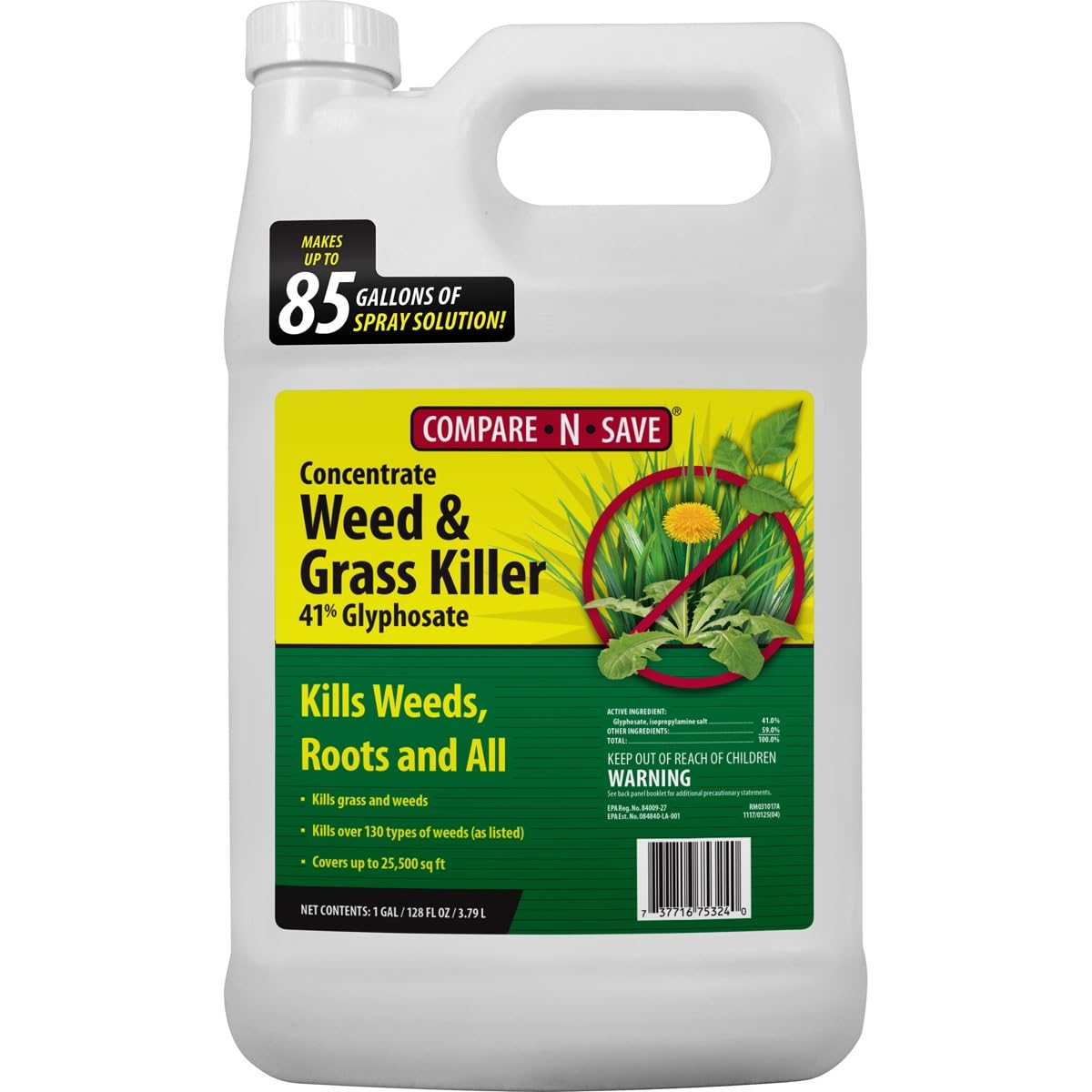
With 41% glyphosate covering up to 25,000 square feet per gallon at a budget-friendly price, Compare-N-Save delivers the core value homeowners need for total vegetation control. Its performance matches name-brand alternatives, making it a direct competitor without the premium markup.

This concentrate is ideal for homeowners managing large lawns, driveways, or fence lines who want cost-effective, non-selective weed control. Results appear over one to two weeks, and tough weeds like poison ivy or brush may need a follow-up application — patience is part of the process.

Plan for up to two weeks to see full results; tough weeds may need a second spray.

Bottom line: Buy this if you want the best per-square-foot value in glyphosate concentrate and can accept a one- to two-week wait for full results.

9

RM43 32oz Conc.

RM43 32oz Conc.

Spot small areas

Our Score 9.0/10
Check Price

Worth Noting

  • Mixing ratios are vague, requiring extra research to get the right dilution.
Form
Concentrate
Coverage
4,324 sq ft
Selectivity
Non-selective
Active Ingredient
Glyphosate + Imazapyr
Read the full review

This 32oz concentrate delivers the same vegetation-stopping power as the gallon version for gravel driveways and patios. But the unclear mixing ratios make preparation a guessing game, and the smaller coverage suits only those who don't need the bulk.

Bottom line: A reasonable pick for DIYers comfortable figuring out dilution who need a small batch of total vegetation control.

10

Sedgehammer Plus

Sedgehammer Plus

Nutsedge control

Our Score 8.8/10
Check Price

Worth Noting

  • Full control may require repeated applications as sedge can regrow after the first treatment.
Form
Dry powder packets
Coverage
2,000 sq ft
Selectivity
Selective (nutsedge)
Active Ingredient
Halosulfuron-methyl
Read the full review

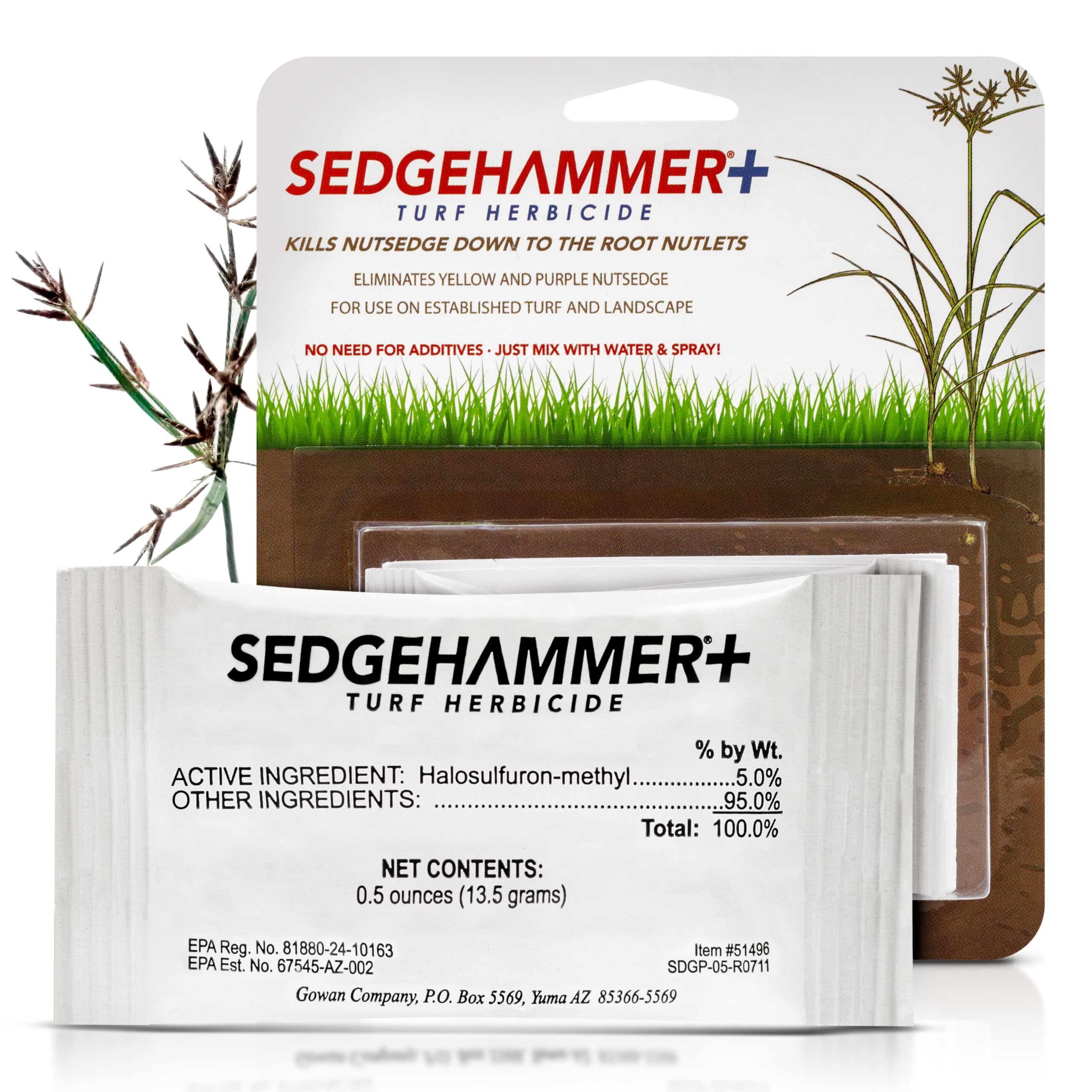
Sedgehammer Plus zeroes in on nutsedge and other sedges without damaging most turfgrasses like Bermuda, fescue, or zoysia. This selectivity makes it the go-to product when broad-spectrum herbicides would kill the grass you want to keep. The two water-soluble packets cover 2,000 square feet, and the halosulfuron-methyl active ingredient works on nutgrass that ignores general weed killers.

It is best for homeowners with persistent sedge patches in an otherwise healthy lawn, or for turf managers who need a selective option. The tradeoff: complete control can require multiple applications, as sedge may regrow after the first treatment. Budget for a second or third round if the infestation is heavy.

Apply during active growth for best absorption; follow-up treatments may be needed 4-6 weeks later.

Bottom line: For homeowners fighting nutsedge without nuking the whole yard, this is the right tool — but budget for repeat sprays if the infestation is established.

11

Spectracide 1G RTU

Spectracide 1G RTU

Small spot spray

Our Score 8.8/10
Check Price

Worth Noting

  • Sprayer trigger may not function or the piece could be absent from the package.
Form
Ready-to-use spray
Coverage
300 sq ft
Selectivity
Non-selective
Active Ingredient
Diquat + Fluazifop
Read the full review

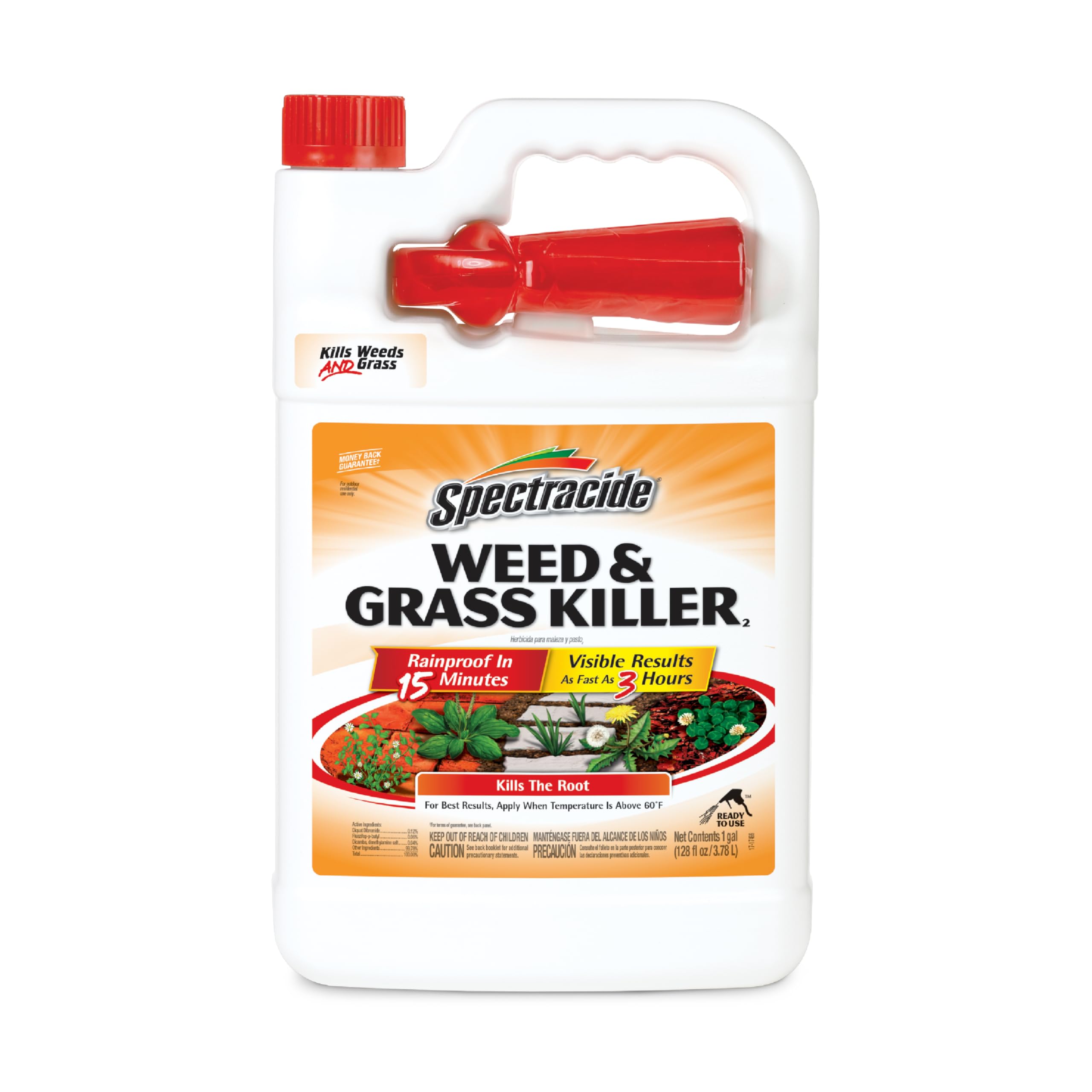
At under $7 per gallon, this kills visible weeds within hours — faster than many glyphosate concentrates. The sprayer is where the value takes a hit: some units have a non-functional trigger or lack the piece entirely.

Best for homeowners who already own a sprayer and need a cheap, fast solution for small areas like driveway cracks and walkways. The 300 sq ft coverage suits these jobs but not larger infestations.

Keep your own sprayer handy — the included unit may need replacement.

Bottom line: A practical choice for quick weed killing on small hard surfaces, provided you have your own sprayer.

12

So. Ag 2,4-D 32oz

So. Ag 2,4-D 32oz

Broadleaf lawn weeds

Our Score 8.8/10
Check Price

Worth Noting

  • Dosage instructions can be confusing for hose-end sprayer users
Form
Concentrate
Coverage
5,000 sq ft
Selectivity
Selective (broadleaf)
Active Ingredient
2,4-D
Read the full review

This concentrate kills broadleaf weeds like dandelions and clover without harming grass, and the low dosage per gallon makes it economical for lawn owners willing to calculate their own ratios. However, the instructions are confusing (pints per acre rather than home-friendly amounts) and overdosing or applying in hot conditions can damage turf. Best for experienced DIY mixers who want a budget-friendly selective weed killer and can follow careful dilution guidelines.

Bottom line: A cheap selective weed killer for lawn owners who are comfortable mixing their own sprays and don't mind a learning curve — skip this if you want a foolproof ready-to-use product.

13

Hi-Yield Killzall 1G

Hi-Yield Killzall 1G

Budget large area

Our Score 8.8/10
Check Price

Worth Noting

  • Effectiveness can be inconsistent - some applications may not kill weeds
Form
Liquid concentrate
Coverage
25,600 sq ft
Selectivity
Non-selective
Active Ingredient
Glyphosate 41%
Read the full review

This 41% glyphosate concentrate covers 25,600 sq ft at a low cost and mixes easily. However, no price data is available to verify long-term value, making it a gamble compared to alternatives with transparent pricing.

Bottom line: Best for buyers covering large areas on a tight budget who can tolerate occasional reapplication and don't require transparent pricing.

How to Choose

Active Ingredient

Glyphosate is the workhorse of non-selective herbicides, killing most plants it touches by blocking an enzyme essential for growth. Selective ingredients like 2,4-D, dicamba, and triclopyr mimic plant hormones and cause uncontrolled growth only in broadleaf weeds, leaving grasses unharmed.

If you’re treating a lawn, a selective formula stops you from accidentally killing the grass. For driveways and gravel, glyphosate is faster and cheaper. Specialized ingredients like halosulfuron-methyl target nutsedge specifically.

Form

Concentrates require mixing with water in a sprayer but offer the lowest cost per square foot. Ready-to-use (RTU) sprays are convenient for small areas but cost more per treatment and often come with unreliable sprayer attachments.

Granular weed-and-feed products combine fertilizer with selective herbicide, but the weed control is weaker than liquid concentrates and timing depends on both weed growth and lawn feeding needs.

Coverage Area

Coverage estimates assume even application and correct dilution. A gallon of concentrate that claims 25,000 sq ft will treat a large lawn, but using it on a 300 sq ft patio wastes money and risks over-spray. Match product volume to your job size.

For small spots, a 32-oz bottle or RTU spray is more economical. For acreage, a 2.5-gallon jug of concentrate gives the best per-square-foot cost.

Selectivity

Non-selective herbicides kill any plant they touch, including grass. Selective products contain specific chemistry that only affects broadleaf weeds or grassy weeds, making them safe for turf when applied correctly.

Misapplying a non-selective product on a lawn is the most common mistake. If you want to keep your grass, always verify that the label says safe for your turf type.

Pre-Emergent Capability

Standard post-emergent killers only eliminate existing weeds. Pre-emergent herbicides (like imazapyr in RM43) prevent seeds from germinating, keeping treated areas bare for months. This is useful for gravel paths and fence lines where regrowth is constant.

The trade-off: pre-emergents sterilize the soil. Don’t use them near flower beds, vegetable gardens, or anywhere you plan to plant later. The 'year-long' claim often falls to 3–6 months in practice.

Frequently Asked Questions