Soil & Fertilizer

11 Best Fertilizer for Roses in 2026: Get Big Blooms Without Overspending

Find the best fertilizer for roses in 2026. This guide helps you choose the right formula for your garden, from budget all-purpose to premium boosters.

Many gardeners assume they need a specialized rose food to get picture-perfect blooms. In reality, a well-chosen all-purpose fertilizer often delivers the same results at a lower cost.

The real challenge is not picking a 'rose-specific' label – it is understanding whether you need fast-acting water-soluble feed for active growth, a slow-release option for low-maintenance care, or an organic mix that improves soil health. Each approach has clear trade-offs.

This guide focuses on the key factors – NPK ratio, form, and application frequency – to help you match the fertilizer to your rose garden's actual needs, not marketing claims.

1

Miracle-Gro All Purpose 3lb

Top Pick
Miracle-Gro All Purpose 3lb

Beginners & casual

Our Score 9.6/10
Check Price

Worth Noting

  • Not suitable for organic gardens due to synthetic chemical composition - a compatibility boundary, not a defect.
Form
Water-soluble powder
NPK Ratio
24-8-16
Application
Mix every 7-14 days
Organic/Synthetic
Synthetic
Read the full review

The water-soluble powder dissolves instantly and feeds plants with a balanced 24-8-16 NPK. Roses respond with more blooms and deeper color, while vegetables and houseplants show steady growth. One 3 lb box covers 1,200 sq ft, making it cost-effective for mixed gardens.

This fertilizer suits beginners who want a single product for everything and rose growers on a budget. The synthetic formula means it won't satisfy organic gardeners - if you need certified organic inputs, look elsewhere. For everyone else, it's a straightforward way to get consistent results without juggling multiple bottles.

Bottom line: If you grow roses and don't require organic inputs, this is the most practical all-purpose fertilizer you can buy for the whole garden.

2

Osmocote Smart-Release 2lb

Osmocote Smart-Release 2lb

Busy gardeners

Our Score 9.6/10
Check Price

Worth Noting

  • No immediate bloom boost; nutrients release too slowly for quick corrections
  • Over-application may lead to excess nutrients; measure carefully
Form
Granular slow-release
NPK Ratio
Application
Apply once per season
Organic/Synthetic
Synthetic
Read the full review

Osmocote delivers six months of steady feeding from one application, a clear contrast to water-soluble fertilizers that need mixing every two weeks. The granules release nutrients gradually, supporting consistent growth and blooming with minimal effort. This suits gardeners who want to apply once and move on, but the slow release means no quick fixes for nutrient deficiencies or lagging blooms – plan ahead and accept the delayed response.

Apply at the start of the growing season so the slow-release timing matches when roses need the most nutrients.

Bottom line: A straightforward choice for rose growers who prefer low-maintenance feeding and don't need rapid results – the long duration makes it a reliable season-long partner.

3

Jack's Classic Blossom Booster

Jack's Classic Blossom Booster

Big bloom seekers

Our Score 9.6/10
Check Price

Worth Noting

  • Can trigger excessive leaf growth if applied before buds form; best reserved for the bloom phase only
Form
Water-soluble powder
NPK Ratio
10-30-20
Application
Mix per gallon
Organic/Synthetic
Synthetic
Read the full review

Jack's Classic Blossom Booster delivers a 10-30-20 formula specifically designed to maximize bloom count and color intensity. While the all-purpose top pick covers all growth stages, this specialized powder focuses energy on flowers, making it the clear choice for rose lovers who already have a base nutrition program and want to push flowering further.

Best suited for gardeners who prioritize spectacular blooms over balanced plant nutrition. Apply only during the bloom phase — using it too early can shift energy to leaves at the expense of roots and flowers. If you need an all-purpose feed, look elsewhere; if you want explosive color, this is it.

Apply only once flower buds begin to form; using it earlier may shift energy to leaves rather than roots and blooms.

Bottom line: For rose enthusiasts fixated on maximizing flower size and quantity, this booster delivers — just time it right.

4

Proven Winners Plant Food

Proven Winners Plant Food

Experienced gardeners

Our Score 9.6/10
Check Price

Worth Noting

  • Can cause leaf burn if the dosage is not measured exactly
Form
Water-soluble powder
NPK Ratio
24-12-17
Application
Mix weekly during growth
Organic/Synthetic
Synthetic
Read the full review

This concentrated powder (24-12-17) drives vigorous flowering on annuals and container plants when mixed correctly. The catch: even slight overshoot can scorch leaves, so it rewards gardeners who measure precisely and understand their plants' needs. For those seeking a forgiving all-purpose feed, the top pick offers more margin for error.

Bottom line: A precise tool for experienced container gardeners who want maximum bloom output and are willing to manage the dosage risk.

5

FoxFarm Grow Big 1qt

FoxFarm Grow Big 1qt

Vegetative growth

Our Score 9.6/10
Check Price

Worth Noting

  • Premium price for a single-stage fertilizer when all-purpose options cost less.
Form
Liquid concentrate
NPK Ratio
6-4-4
Application
Dilute per label
Organic/Synthetic
Synthetic
Read the full review

This liquid concentrate delivers a fast-acting 6-4-4 NPK that pushes lush leafy growth on roses, tomatoes, and houseplants — exactly what you want during vegetative stages. But it is a single-stage product, not a complete feed. To get blooms and fruit, you will need a separate bloom booster or the full FoxFarm Trio system. That makes sense for growers who follow a multi-phase program and want precise control, but it is expensive compared to all-purpose alternatives that cover the whole season.

Bottom line: Best suited for gardeners already on the FoxFarm schedule who want targeted vegetative feeding; skip it if you prefer a single all-purpose product.

6

FoxFarm Trio 3-Pint

FoxFarm Trio 3-Pint

Serious rose enthusiasts

Our Score 9.4/10
Check Price

Worth Noting

  • Premium-priced compared to single-bottle fertilizers.
  • Requires following a three-bottle feeding schedule, more complex than a one-step product.
Form
Liquid concentrates
NPK Ratio
Stage-specific
Application
Follow stage schedule
Organic/Synthetic
Mixed
Read the full review

The FoxFarm Trio delivers stage-specific nutrition with three concentrated liquids: Grow Big for vegetative growth, Tiger Bloom for flowering, and Big Bloom as an organic base. This system gives dedicated rose enthusiasts precise control over each growth phase, resulting in larger flowers and healthier plants. It is best for gardeners who treat feeding as a deliberate regimen rather than a weekly chore. The three-bottle approach and scheduled applications demand more attention than a simple one-step product, and the premium price reflects the higher concentration and performance.

Follow the feeding schedule on each bottle and adjust based on plant response for best results.

Bottom line: The FoxFarm Trio suits rose growers who want precise stage-by-stage control and are willing to invest both time and money for superior results.

7

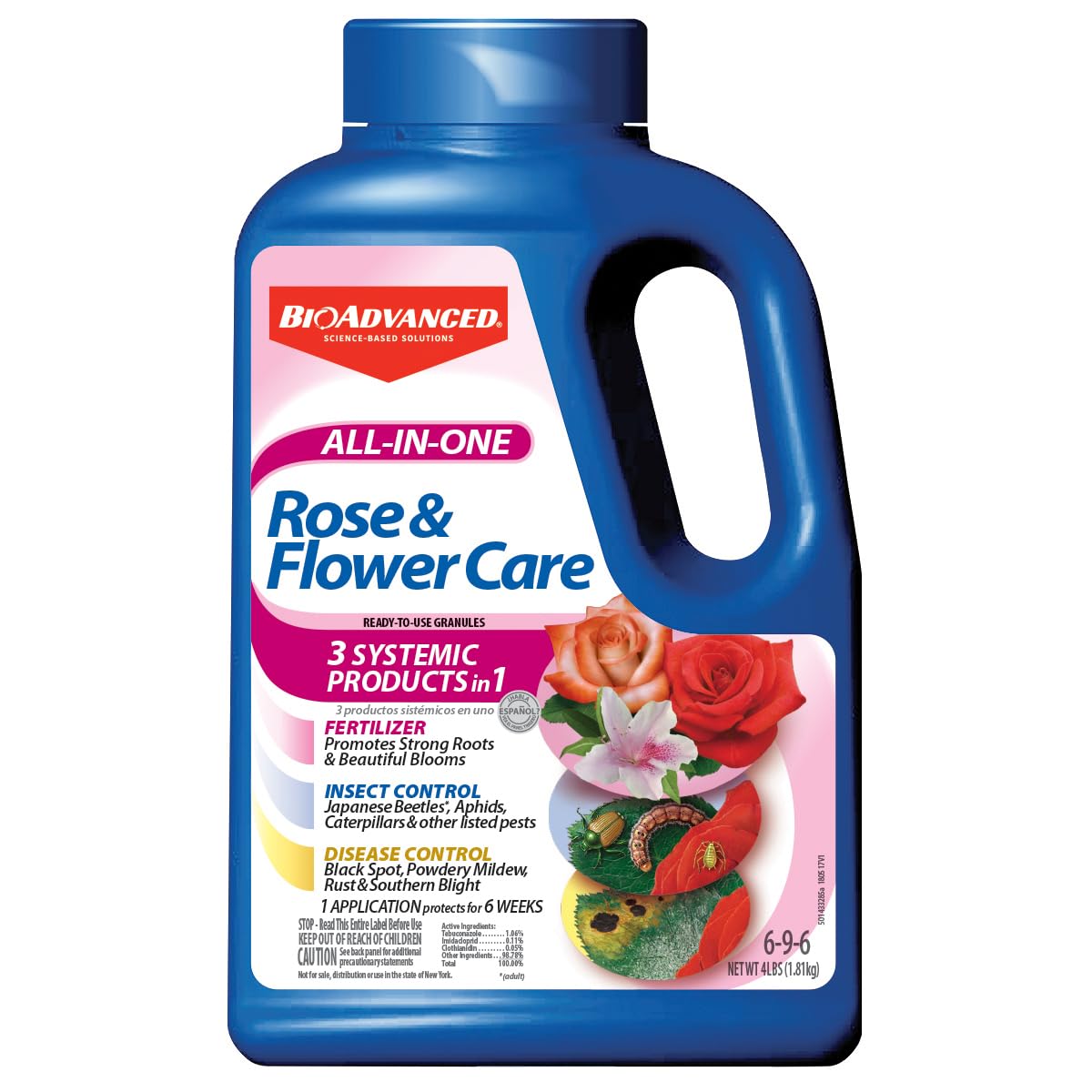
BioAdvanced Rose & Flower Care

BioAdvanced Rose & Flower Care

Pest-prone roses

Our Score 9.4/10
Check Price

Worth Noting

  • Container lid can be difficult to open, requiring extra effort or tools.
  • Higher cost per application compared to separate fertilizer and pesticide products.
Form
Granules systemic
NPK Ratio
Application
Apply every 6 weeks
Organic/Synthetic
Synthetic
Read the full review

BioAdvanced Rose & Flower Care combines fertilizer, insecticide, and fungicide in one granular application, targeting common rose problems like aphids, Japanese beetles, and black spot. The systemic granules release nutrients and active ingredients for up to six weeks, reducing the need for multiple products.

This product suits gardeners who want minimal effort and have regular pest or disease pressure on their roses. The container lid can be tough to open — a gripper may help — and the cost per application is higher than buying separate products, which may not appeal to those on a tight budget or without pest issues. It uses synthetic pesticides, so it is not suitable for organic gardens.

Lid twists off with extra grip — try using a rubber band for leverage.

Bottom line: Best for rose growers who want to simplify their routine and have pest or disease issues — the convenience offsets the higher cost and lid annoyance for those with moderate pest pressure.

8

Miracle-Gro Shake 'N Feed Rose

Miracle-Gro Shake 'N Feed Rose

Low-maintenance feeding

Our Score 9.4/10
Check Price

Worth Noting

  • Relies on soil moisture and temperature to release; not suitable for gardeners needing an immediate boost.
Form
Granules slow-release
NPK Ratio
Application
Shake on every 3 months
Organic/Synthetic
Synthetic
Read the full review

Unlike water-soluble formulas that require mixing and weekly application, this slow-release granular feed spreads in seconds and keeps feeding for up to three months. The tradeoff is that nutrients take time to become available – it won't revive a struggling rose overnight, but it eliminates the effort of regular fertilizing.

Best suited for gardeners who want to apply once and forget about feeding for the season. If you prefer the control of adjusting dosage week by week or need an immediate bloom boost, a water-soluble option like the top pick would be a better fit.

Apply at the start of the growing season and let rain and irrigation activate the granules gradually – don't expect visible results in the first week.

Bottom line: A solid choice for anyone who wants to simplify rose feeding – just apply once and let the granules do the work over the months.

9

Dr. Earth Bud & Bloom

Dr. Earth Bud & Bloom

Organic rose growers

Our Score 9.4/10
Check Price

Worth Noting

  • Strong, unpleasant odor may linger after application
Form
Granules
NPK Ratio
3-9-4
Application
Top-dress monthly
Organic/Synthetic
Organic
Read the full review

This granular organic fertilizer uses a 3-9-4 NPK blend and mycorrhizae to promote abundant flower production and long-term soil vitality. It is best incorporated into soil rather than used as a liquid feed. However, the strong, lingering odor can be off-putting, making it unsuitable for indoor use or near patios.

Bottom line: Best for dedicated organic rose growers who work in open garden spaces and don't mind the smell.

10

Scotts All Purpose 3lb

Scotts All Purpose 3lb

Budget gardens

Our Score 9.4/10
Check Price

Worth Noting

  • General-purpose formula lacks the extra phosphorus needed for peak rose blooms.
Form
Granules continuous release
NPK Ratio
Application
Apply every 2 months
Organic/Synthetic
Synthetic
Read the full review

This budget-friendly continuous-release fertilizer works well for general flower and vegetable beds, providing steady feeding for up to two months with minimal effort. For rose enthusiasts seeking maximum bloom size, the lower phosphorus content means it won't match specialized formulas or water-soluble bloom boosters. Stick with this if you maintain a mixed garden and want a simple, no-fuss granular feed, but look to the slow-release rose-specific option if roses are your priority.

Bottom line: A good value for mixed flower and vegetable gardens, but rose specialists should choose a phosphorus-heavy bloom booster instead.

11

BioAdvanced 2-in-1 Rose Care

BioAdvanced 2-in-1 Rose Care

Budget insect control

Our Score 9.4/10
Check Price

Worth Noting

  • Lid may be very difficult to open, requiring significant force or tools
Form
Granules systemic
NPK Ratio
Application
Apply every 8 weeks
Organic/Synthetic
Synthetic
Read the full review

Fertilizes and protects roses from aphids, Japanese beetles, and other insects for up to 8 weeks with one application. The granules feed plants and produce abundant blooms, making it a cost-effective alternative to separate products. However, this version lacks disease control — the All-In-One is better if you need fungicide. The lid design can also be stubborn to open.

Bottom line: Budget-friendly rose care for those who prioritize insect control over disease prevention; expect a tough lid.

How to Choose

NPK Ratio: What Do Those Numbers Mean?

The three numbers on a fertilizer label represent nitrogen (N), phosphorus (P), and potassium (K). Nitrogen promotes leafy growth, phosphorus supports root and bloom development, and potassium improves overall plant health.

For roses, many gardeners look for a higher middle number (phosphorus) to encourage flowers. However, a balanced all-purpose formula like 24-8-16 can still produce excellent blooms because it provides sufficient phosphorus for most rose varieties. Overemphasizing phosphorus can sometimes lead to lush foliage at the expense of roots.

Form: Water-Soluble, Liquid, or Granular?

Water-soluble powders and liquid concentrates offer the fastest uptake – ideal for giving roses a quick boost during active growth or correcting deficiencies. The trade-off is that they require more frequent application (every 7–14 days) and careful measuring to avoid burning roots.

Granular slow-release fertilizers dissolve over weeks or months. They reduce maintenance but cannot fix immediate nutrient shortages. This form works well for gardeners who prefer a set-and-forget approach or have a busy schedule.

Organic vs. Synthetic Ingredients

Organic fertilizers (e.g., Dr. Earth) derive from plant or animal matter. They feed soil microbes and improve long-term soil structure, but release nutrients slowly and often produce a strong smell during decomposition.

Synthetic fertilizers deliver nutrients in a readily available form, giving faster and more predictable results. However, overuse can lead to salt buildup in soil, harming root health. Many synthetic formulas are cost-effective and reliable for consistent blooms.

Application Frequency and Ease

How often you need to fertilize depends on the form and your roses' growth stage. Water-soluble types require mixing and applying every 1–2 weeks. Slow-release granules can last from 2 to 6 months with a single application.

Match the schedule to your lifestyle: if you enjoy weekly garden maintenance, water-soluble gives you precise control. If you prefer to set and forget, a timed-release granular product is the better fit.

Frequently Asked Questions