Soil & Fertilizer

14 Best Soil Moisture Meter of 2026: Match Your Pot Depth and Budget

Which soil moisture meter works for your indoor pots or raised beds? This guide helps you choose based on probe length and realistic lifespan.

A soil moisture meter should be the simplest tool in your shed: push it in, read the dial, water accordingly. But after a few months, many start reading dry no matter how wet the soil is, or the probe tip snaps off. It is not a design flaw — it is what happens when cheap manufacturing meets daily use.

The real choice is between a standard probe for houseplants and a long probe for deep containers. Standard meters are fine for small pots, but they cannot reach the root zone of raised beds or large planters. A long probe adds reach but may be too thick for delicate nursery pots.

None of these meters will last forever. The practical approach is to pick the right length for your pots, expect a season or two of use, and keep the probe clean and dry between readings.

1

XLUX Long Probe

Top Pick
XLUX Long Probe

Deep pots

Our Score 9.0/10
Check Price

Worth Noting

  • Probe may detach from the handle after extended use in some units.
  • Probe diameter is too wide for very small pots.
Probe Count
Single
Probe Length
10.5 in
Build Material
Metal
Read the full review

The XLUX Long Probe reaches root zones in large containers and raised beds that shorter meters cannot access, and its easy-to-read dial and battery-free operation make it straightforward to use. Accuracy holds well for most gardeners, and the metal probe handles repeated insertion without bending.

This model is best for gardeners with deep pots, outdoor planters, or ground soil where the root zone is several inches down. The tradeoff: some units have shown the probe detaching from the handle after weeks of use, though this appears less common than with other long-probe meters. The probe diameter also makes it unsuitable for very small pots, so it's not a one-size-fits-all tool.

The probe's thickness suits large pots best; for small succulents, consider a slimmer alternative.

Bottom line: For gardeners with deep containers or raised beds, this meter offers reach no other analog meter provides, though occasional durability issues mean it's not a lifetime tool.

2

Dr.meter S10

Dr.meter S10

Budget gardening

Our Score 9.0/10
Check Price

Worth Noting

  • Probe tip may detach after extended use
  • Not designed for hard or rocky soil; probe may be difficult to insert or could bend.
Probe Count
Single
Probe Length
Build Material
Stainless steel
Read the full review

The Dr.meter S10 delivers clear, color-coded moisture readings at a price that makes it easy to buy several for a large plant collection. The single stainless steel probe requires no batteries and is simple to read. But the tip can separate from the body after a few months of use, and the meter is not intended for hard or rocky soil — it is best treated as a seasonal tool for budget-conscious gardeners who monitor many pots.

Avoid forcing the probe into compacted ground to reduce tip separation over time.

Bottom line: If you need a low-cost meter for a season's worth of watering checks and plan to replace it yearly, this does the job without breaking the bank.

3

UNIWA Ladybug

UNIWA Ladybug

Gift giving

Our Score 9.0/10
Check Price

Worth Noting

Probe Count
Single
Probe Length
Build Material
Read the full review

The UNIWA Ladybug is a charming novelty meter that adds a playful touch to watering routines. Its cute ladybug shape and color-coded dial make it an easy gift for casual plant owners or children learning about gardening. However, some units may show a dry reading even when the soil is damp, and the antenna can detach from the body. These quirks matter less for decorative plant care or as a teaching tool, but serious gardeners should look elsewhere.

Bottom line: Ideal as a gift or for introducing kids to plant care, but not a tool for accurate moisture monitoring.

4

Simply Conserve Frog

Simply Conserve Frog

Kids/novelty

Our Score 9.0/10
Check Price

Worth Noting

  • Dial may be difficult to read without bending low to the pot.
Probe Count
Single
Probe Length
Build Material
Read the full review

The froggy design makes this meter a hit with children, adding a playful element to watering. It works well enough for occasional checks, but the dial is hard to read from a standing position and accuracy can be off in dry soil — fine for light use where precision isn't the goal.

Bottom line: Works as a low-stakes novelty for children or casual plant owners who don't mind bending, but not for precise watering or standing-position reading.

5

XLUX T10

XLUX T10

Indoor houseplants

Our Score 8.8/10
Check Price

Worth Noting

  • Slim probe tip may snap if pushed into hard or dry soil.
  • Some units can produce inaccurate dry readings after extended use.
Probe Count
Single
Probe Length
Build Material
304 Stainless Steel
Read the full review

Over 70,000 ratings and a design that has been in continuous production since 2015 make this one of the most recognizable analog meters. For deep containers, the top pick's longer probe reaches root zones this model cannot, so it's best suited for standard indoor houseplant pots. The slim probe tip may snap if forced into compact soil, and some units can deliver inaccurate dry readings after a few months. It fits budget-conscious owners who want a simple tool for basic watering guidance.

Insert the probe gently and wipe it clean after each use to help maintain accuracy.

Bottom line: A serviceable entry-level meter for indoor pots, best treated as a seasonal tool given the possibility of tip damage or reading drift.

6

Antonki 2-Pack

Antonki 2-Pack

Multiple plants

Our Score 8.8/10
Check Price

Worth Noting

  • Probe tip may come loose after extended use.
  • Readings can be inconsistent
Probe Count
Single
Probe Length
7.6 in
Build Material
Metal
Read the full review

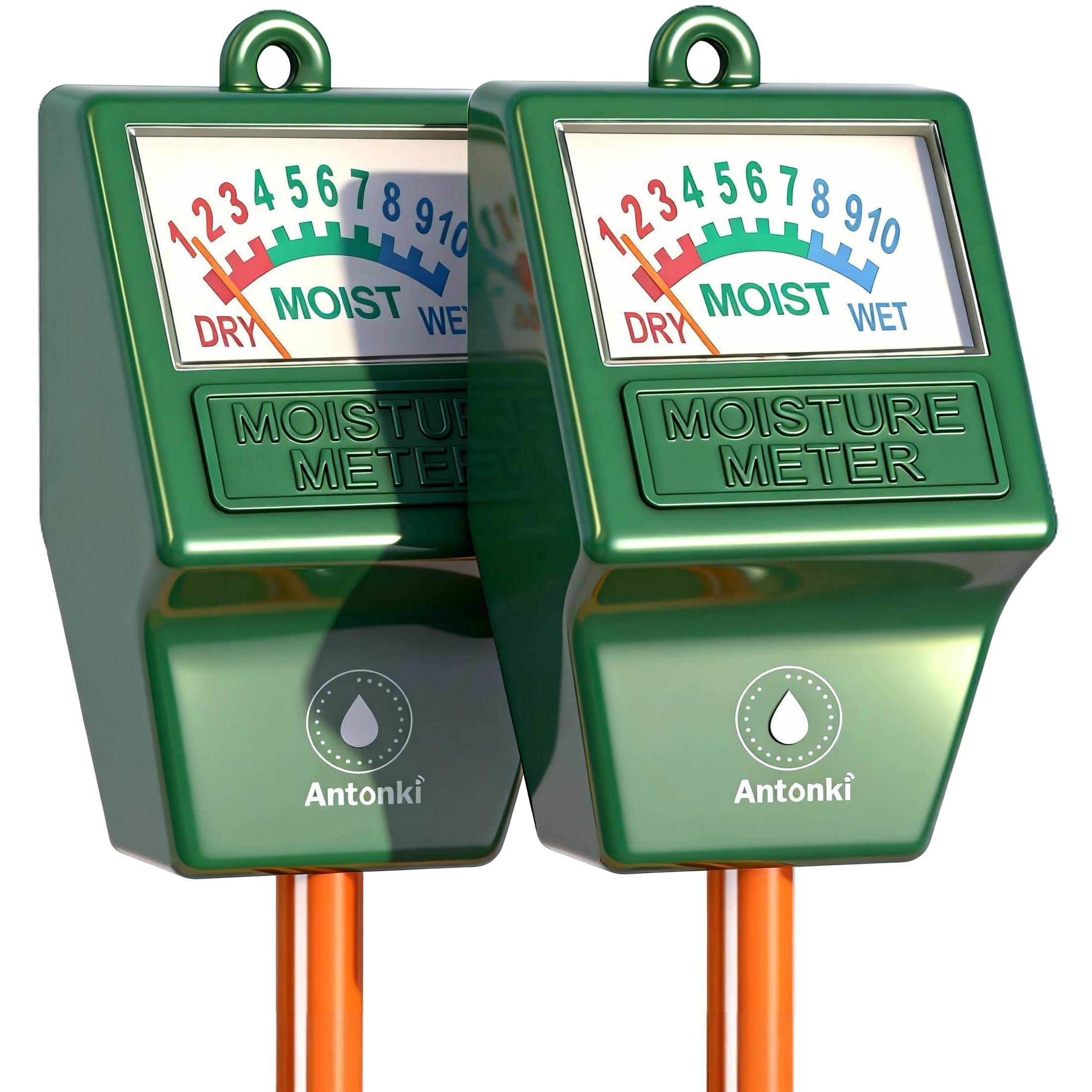
Two meters in one pack means you can leave one in the garden and keep another by your houseplants — a simple setup for homes with multiple watering stations. Each meter requires no batteries and gives a quick soil moisture reading via a clear dial. For the price, the accuracy is adequate for casual checks, though some units may indicate dry soil even when damp. The metal probe tips can detach after several months of regular use, a known limitation of budget meters. This set is best for beginners building their plant care kit, gift-giving to new plant owners, or anyone who wants a spare meter on hand without paying twice.

Wipe the probe clean after each use and avoid twisting when inserting to reduce stress on the tip.

Bottom line: Best for casual plant owners with multiple pots who want a simple, cost-effective check — just be prepared for possible tip wear over time.

7

Classy Casita

Classy Casita

Stylish indoor

Our Score 8.8/10
Check Price

Worth Noting

  • Some units may become unresponsive after a period of use.
  • Moisture readings can be inconsistent, particularly in very dry soil.
Probe Count
Single
Probe Length
Build Material
Read the full review

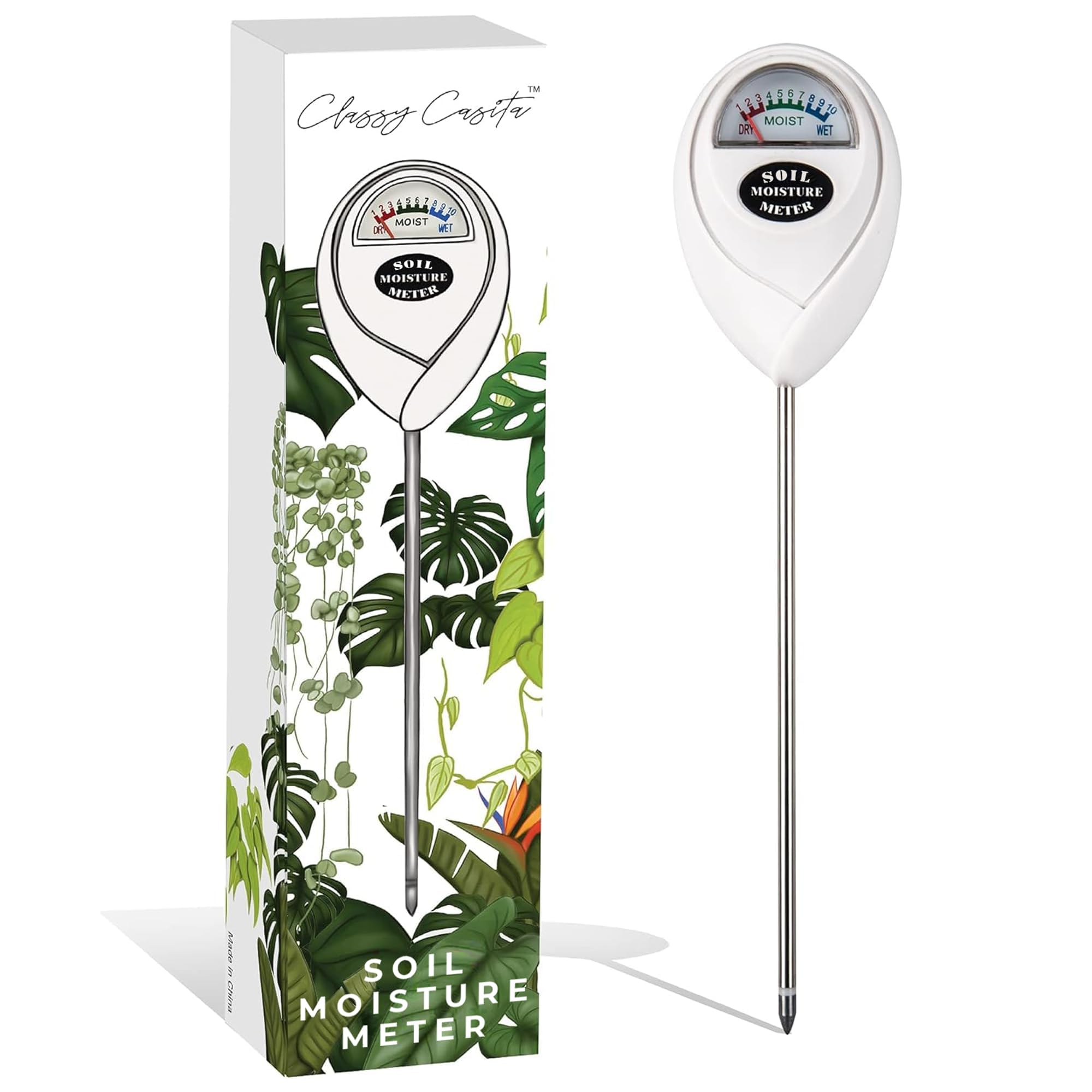
The Classy Casita stands out among budget meters for its minimalist white design — it’s the only model in this roundup that doesn’t look out of place on a white windowsill. It delivers color-coded readings with a single probe, and no batteries are needed, making it easy for casual plant owners to use.

Performance is average: some units may become unresponsive after a short time, and moisture readings can be inconsistent, especially in dry soil. This meter suits indoor plant enthusiasts who value a clean home aesthetic over long-term reliability — ideal for living room plants where appearance matters as much as the reading.

Bottom line: If a clean white aesthetic is non-negotiable, this meter fits that need — just be prepared for occasional quirks in longevity and accuracy.

8

Gouevn G01

Gouevn G01

Short-term use

Our Score 8.8/10
Check Price

Worth Noting

  • Some units may not function out of the box, and the probe tip can separate after limited use.
Probe Count
Single
Probe Length
Build Material
Metal
Read the full review

At a budget-friendly price, the Gouevn G01 offers a large dial and simple operation for basic moisture checks. Build quality matches the cost — some units may arrive non-functional, and the probe tip can separate after light use. This meter suits gardeners who want a low-commitment backup for short-term projects and don't mind replacing it every few months.

Bottom line: Fine for the occasional quick check on a single houseplant — not a tool for regular or serious gardening.

9

apine Moisture Meter

apine Moisture Meter

Houseplant owners

Our Score 8.8/10
Check Price

Worth Noting

  • Unit can become unresponsive or produce inconsistent readings over time.
Probe Count
Single
Probe Length
Build Material
Metal
Read the full review

The apine Moisture Meter includes a handy wiping cloth to improve accuracy, a thoughtful touch for indoor plant care. However, some units may become unresponsive or give inconsistent readings after several months of use, making this a budget option best for casual checking rather than precision watering.

Bottom line: Works well for houseplant owners who appreciate the included cloth and can tolerate occasional unit variability.

10

SZHLUX Moisture Meter

SZHLUX Moisture Meter

Occasional use

Our Score 8.8/10
Check Price

Worth Noting

  • Moisture readings can show dry when soil is damp, reducing trust in the reading.
Probe Count
Single
Probe Length
10.2 in
Build Material
Metal
Read the full review

The SZHLUX Moisture Meter offers a budget-friendly 10.2-inch probe for occasional indoor plant checks. Its simple operation helps prevent overwatering in small pots. However, moisture readings can indicate dry even when soil is damp, making it less suitable for plants that need consistent monitoring.

Bottom line: Works well for occasional checks on small indoor plants where exact moisture isn't critical.

11

Tennedriv Green

Tennedriv Green

Casual plant care

Our Score 8.8/10
Check Price

Worth Noting

  • Probe tip may come off after a few months of use.
Probe Count
Single
Probe Length
Build Material
Metal
Read the full review

This meter offers a large, clear dial and straightforward operation for light indoor use, helping prevent over- or under-watering. However, the probe tip may come off after a few months, making it a disposable option for casual plant owners rather than a long-term tool.

Bottom line: Best for casual indoor plant owners who want a basic, inexpensive meter and are comfortable replacing it after a season or two.

12

YAMRON CTY Digital

YAMRON CTY Digital

Tech-savvy

Our Score 8.6/10
Check Price

Worth Noting

  • In some cases, pH readings differ from dedicated test kits, reducing reliability of that function.
Probe Count
Single
Probe Length
Build Material
Read the full review

The YAMRON CTY Digital offers a backlit LCD and rotating head for easy reading in dim light, and adds temperature and light sensing alongside moisture. It suits tech-oriented gardeners who want those extras. But the pH reading can disagree with test kits, and the meter needs 4 AAA batteries — no auto-off means you may drain them if forgotten. For traditional battery-free analog seekers, this misses the mark.

Bottom line: Works well for moisture and temperature tracking if you prefer digital readouts, but treat the pH reading as a rough guide and remember to turn it off after use.

13

Kensizer Soil Tester

Kensizer Soil Tester

Moisture only

Our Score 8.4/10
Check Price

Worth Noting

  • pH reading may indicate neutral regardless of actual soil acidity
Probe Count
Single
Probe Length
Build Material
Read the full review

This meter combines moisture, pH, and light readings at a mid-range price. The moisture function works well for basic plant care. However, the pH reading may not vary from neutral, and the probe is delicate — the extra functions are best ignored.

Bottom line: Suits casual users who only need a moisture check and are willing to overlook the extra functions.

14

Raintrip 4-in-1

Raintrip 4-in-1

Deep containers

Our Score 8.2/10
Check Price

Worth Noting

  • pH and nutrient readings can be unreliable
Probe Count
Single
Probe Length
Build Material
Read the full review

The rotating dial is a thoughtful design: it swivels 90 degrees so you can read moisture levels without bending. That makes it a practical tool for gardeners with back pain. However, the pH and nutrient sensors offer little value – readings often don't budge. The probe is also long, making it less suitable for small pots. Stick to the moisture function and this becomes a usable, gift-worthy meter.

Bottom line: A good pick if you only need moisture readings, value the rotating dial, or want a gift; ignore the extra sensors.

How to Choose

Probe Length: Standard vs. Long

Standard probes (around 7 inches) are ideal for small to medium pots — they reach the root zone without poking through drainage holes. Long probes (10 inches or more) are necessary for deep containers, raised beds, and outdoor planters where moisture collects lower in the soil.

A longer probe also saves you from bending over as far, which matters if you have many floor-level pots. But it can be too thick for narrow nursery pots, and inserting it into hard soil requires more force. Match the length to your deepest pot, not the average one.

Probe Count: Single vs. Dual

Nearly all moisture-only meters use a single probe — the electrical resistance between the probe and the surrounding soil determines the reading. Dual-probe meters are almost always multi-function devices that also claim to measure pH or light. In practice, the second probe does not improve moisture accuracy.

If you only need moisture readings, a single-probe meter is simpler and less likely to break. Dual-probe meters often have more fragile connections and the extra functions are frequently unreliable.

Build Material: Stainless Steel vs. Generic Metal

Stainless steel probes resist corrosion from moisture and soil acids. Generic metal probes can rust if left in the soil for long periods, especially in damp outdoor conditions. Rust accelerates probe degradation and can cause inaccurate readings.

Wipe the probe dry after each use regardless of material. Leaving the meter inserted in the soil for more than five minutes will damage any metal probe over time. A quick storage routine is the best way to extend the meter's life.

Frequently Asked Questions